

Hugh Hazzard &
Bozo the Iron Man
Created by George E. Brenner

NAME + ALIASES:
None
FIRST APPEARANCE:
Smash Comics #1 (Aug. 1939)


Bozo the Robot was the third hero created by George Brenner for Quality Comics. Bozo even preceded Quality’s first super-hero, the Doll Man, by several months. Save for its robotic nature, historically significant name, and occasional bursts of excitement, the character was forgettable.
Bozo was an iron robot originally created by the criminal Dr. Von Thorp, who sent his creation to terrorize the city. The police were at their wits’ end and Commissioner Hunt called their go-to guy, Hugh Hazzard, for help by sending a flare into the sky. (Batman’s Bat-signal didn’t appear until 1942.) Hazzard managed to stow away inside the robot, which led him back to Von Thorp’s hideout, and to a hasty take down. Afterwards, Hugh learned that the authorities intended to send the robot to a watery grave. Hazzard rushed to save it and named him “Bozo the Iron Man,” his new crime-fighting partner. (Smash #1)
Hazzard wasted no time and added a flying device to the robot. However, Commissioner Hunt was not pleased to learn that Bozo was on the loose again after he’d ordered the robot destroyed. He demanded that Hugh turn it over, but was interrupted by news of a kidnapping. Hazzard saw this as his opportunity to prove Bozo’s worth. He sent Bozo, via radio control, to capture the kidnapper’s plane. After seeing the robot in action, the Commissioner was convinced of its value in crime fighting. Hunt also liked the fact that he could use Hazzard’s services at no expense to taxpayers. (#2)
Herman Weizer of Latavia offered $2 million to Hazzard for Bozo. Hugh refused, declaring that Bozo wasn’t for sale, even after the offer went to $5 million. Since he couldn’t have the robot, Weizer tried unsuccessfully to destroy it with a death ray machine. (#5)
In addressing the world at war in Quality Comics, Brenner did like other writers and gave his villains names like “Hitlin” and the “Batzis.” (#8) He crafted one hopeful tale where Hazzard and Bozo got involved in European affairs, and world peace was declared after the evil dictator Motler was sent to his doom. (#9)
Hugh continued to improve the Iron Man. Usually riding on the robot’s back, he soon was able to enter the robot himself (as he had in the first story), and control it from inside. It was also fitted with a telescopic eye. (#6) His “super-sepericonoscope” could receive audio and video from far distances. (#10)
It wasn’t until he met the modern day Prometheus called Brutus that the robot truly met his match. Brutus was created by a mad scientist who stole body parts from graves. The two fought to a near stalemate until Bozo threw Brutus into his creator, killing both of them. (#14)
Bozo’s creator, Dr. Von Thorp returned once after freeing himself from prison. He reclaimed the Iron Man by making a new device to override Hazzard’s own controls. Hazzard foiled the doctor by hiding away inside the robot to gain entry to Von Thorp’s lair. The evil doctor was wise to him, and locked Hugh into a flooded room. He survived by using his pipe as a straw for air. He eventually managed to smash Von Thorp’s control box, and took Bozo back. The Doctor was later shot and killed while trying to flee from police. (#18)
Bozo fought a few more weird foes like the Headless Men—mobsters who wore special suits to make themselves look headless in order to frighten their victims. (#24) The Clown was the first “super-villain” to really give Bozo a run for his money. This killer struck with poison, and left a calling card bearing his white faced visage. (DC’s Joker had been around for just over a year.) The Clown continued on a crime spree across the city, aimed at taking over organized crime. Hazzard and Bozo managed to track him down, but had their hands full in trying to capture the Clown. With sheer brute force, the Clown sent Bozo flying into the river. Bozo quickly recovered and followed him back to his hideout. It was Bozo’s turn to deliver a beating, and he turned the Clown over to police. (#25)
In the following issue, the evil Akim Topoff and his oriental henchman, Toto, killed the D.A. using a mystical crucible that allowed Topoff to appear and vanish at will. At the end of their struggle, Hugh never thought twice about tying a rock to Topoff’s ankle, and letting him drown. (#26)
For most of Bozo’s final dozen-or-so appearances, the feature degenerated into repetitive plots. A couple of issues before its end, Brenner tried stirring the pot with an interesting story that even included funny animals. A lovable hillbilly named Zeke Punkinhed crossed paths with Bozo while on the trail of a wanted crook. The story also included a sort of “parallel story” which occupied the top portion of every page. This secondary story mirrored Bozo’s adventure as a sort of morality play involving a cat and mouse. (#39)
Another genius inventor Home Twipple created his own bumbling Iron Man. Bozo proved that Twipple’s suit was second best, and it’s a good thing, too. Once Twipple exited the robot, some mobsters blew it to kingdom come. (#40)
Whatever involvement George Brenner had in the feature by the end, he soon gave up creative work and served solely as editor for the rest of his stay at Quality.
Post-Quality
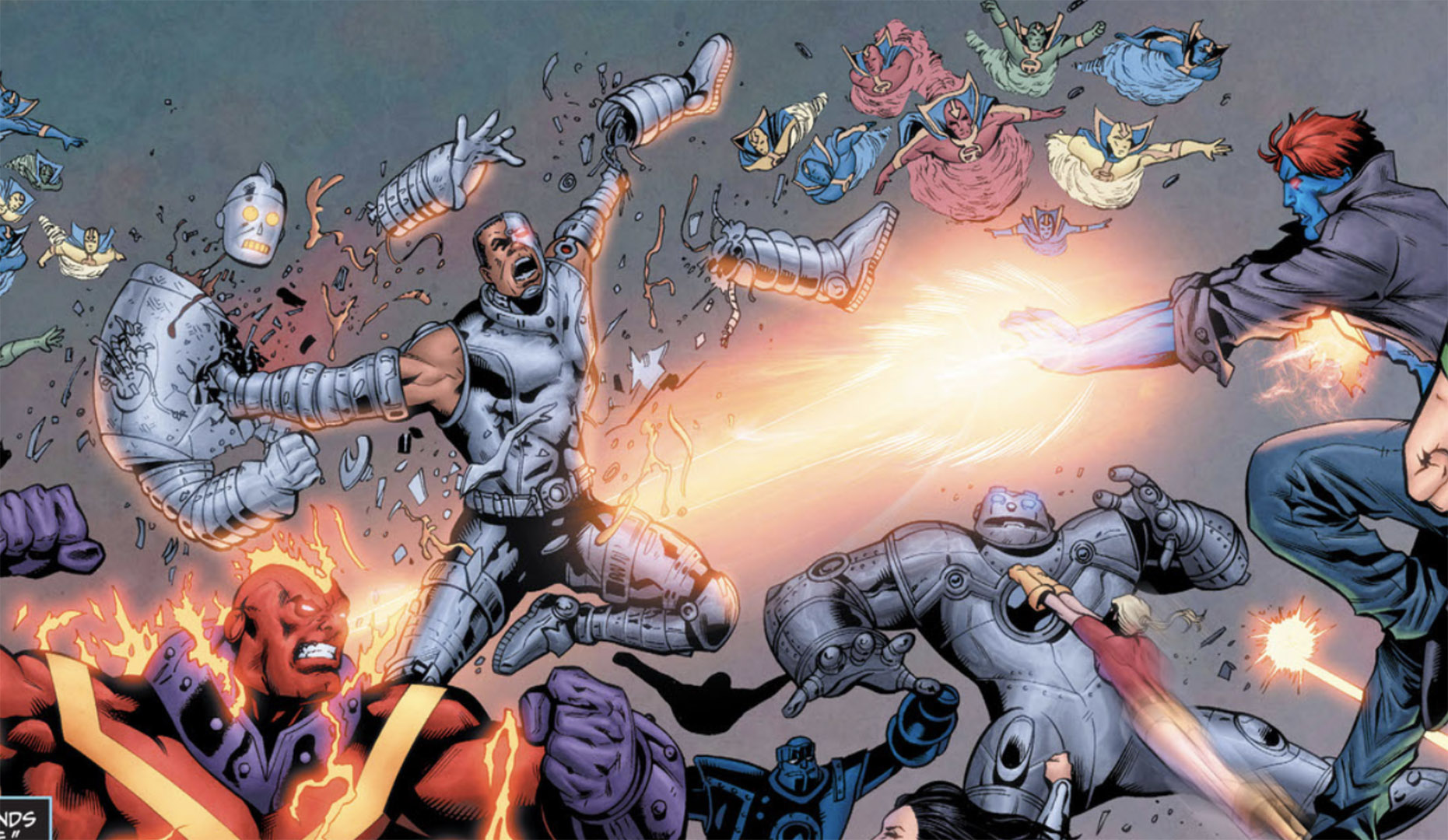
The character of Bozo has seen no formal use since 1943. James Robinson, who wrote Starman in the 1990s, made cryptic references to several Quality characters. In Starman #64, you can catch a glimpse of Bozo in the DC universe. By the 1970s, Bozo’s body had found its way into the hands of a Japanese collector who specialized in heroic memorabilia. Bozo appears among other historical robots from DC lore.
The fate of Hugh Hazzard remains unexplored. Hugh had no known family, but an unnamed girlfriend made a couple of minor appearances.
In a 2007 interview with Newsarama, Justin Gray revealed that the character "Gonzo the Mechanical Bastard evolved from Grant [Morrison]’s original proposal into something very different. Instead of an updated version of Bozo the Iron Man, this creature is tied more closely to the events taking place now as we head into Final Crisis. He arrived as a vanguard to the changes, a wrench in the machine so to speak." Gray and his co-writer Jimmy Palmiotti created Gonzo alongside other Quality legacy characters but he never bore any resemblance to Bozo, nor did it mention any relationship between the two.
This Gonzo originated in another universe and was manipulated by Father Time into killing and replacing Senator Knight (Phantom Lady's father). (Uncle Sam and the Freedom Fighters v.1 #1) Gonzo became the primary foe of this story arc, quickly moving out of Father Time's control. (#2-7) Before Gonzo's destruction, Father Time revealed that the tyrant was the creation of the "Mathmagicians of the Anti-Life Equation," shadowy chaos architects. Gonzo was their probe, dispatched to gather data. Ultimately, Time captured Gonzo in a device and the synthesis became an Orphan Box, a source of raw information. (#8)
Then in 2011, James Robinson wrote a story for Justice League of America #60 that referenced Bozo and Gonzo in context of Grant Morrison's original plan. A robot resembling Bozo was shown being ripped apart by Cyborg, but that was "all he wrote."
Notes

Gray and clunky, just like Bozo. Hmm…
Many fictional robots from the early 20th century probably trace their roots to Fritz Lang’s 1927 silent film, Metropolis, which presented a unique future-world and featured a robotic woman, the Maschinenmensch. Squarish, human-sized robots can also be found in the 1935 Gene Autry serial Phantom Empire.
Most similar to Bozo was a real-life robot that was contemporary to Brenner’s comics career. The golden robot called Elektro was made by the Westinghouse Electric Corporation, and presented at the 1939 New York World’s Fair. It was seven feet tall, and performed a variety of feats (but could not house a human). Elektro was also wide-shouldered and barrel-chested, though Bozo’s facial “expression” seems a bit more friendly. Brenner referenced the World’s Fair in one of his “Clock” stories.
Bozo the Robot preceded television’s famous Bozo the Clown by several years. Marvel Comics’ character, Iron Man, did not debut until Tales of Suspense #39 (April 1963).
Bozo was powerful enough to maintain a bi-monthly cover spotlight through Smash #26. The name of the feature began as “Hugh Hazzard and His Iron Man.” In Smash #12 the “Iron Man” portion was dropped permanently in favor of “Bozo the Robot” (and often omitting Hugh’s name entirely). Another Bozo-like robot was used by the Japanese in the humor feature “Private Dogtag” in Police Comics #28 (1943).
Powers
Bozo’s prowess was mainly quantified by his mechanical strength and ability to fly. It once plowed right through the earth. At first, Hugh Hazzard controlled Bozo by remote control, and even rode on the robot’s back. Soon he added the ability to control Bozo from the inside, wearing it like armor. The robot was airtight and could perform underwater as well. Hugh Hazzard wasn’t afraid to use his own fists, either.