


NAME + ALIASES:
Charles "Chuck" Lane
KNOWN RELATIVES:
Unnamed parents (deceased), unnamed wife and daughter, unnamed son (deceased),
Charles Lane II (grandson, Jester II), Walter Delane (ancestor)
GROUP AFFILIATIONS:
The Arcadians, Freedom Fighters
FIRST APPEARANCE:
Smash Comics #22 (May 1941)
The Original Jester (Quality Comics)
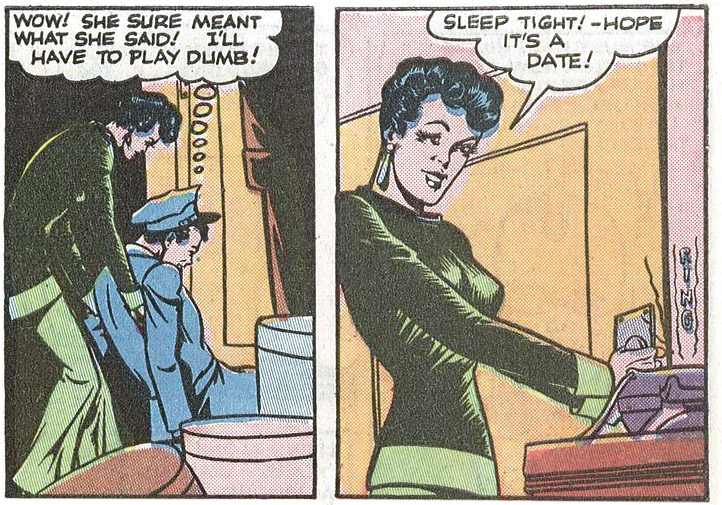

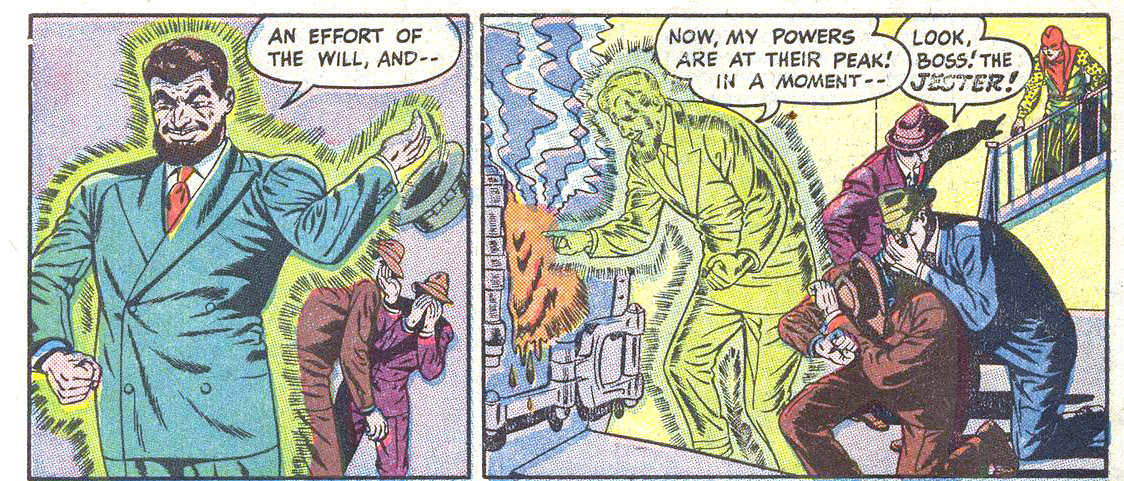
The Jester was another long-running creation by Paul Gustavson, who did the feature for its first two years. The hero’s original costume featured a skull that disappeared after six installments.
As an officer, Lane was a rookie on the New York City police force. As the Jester, he gleefully fought crime in ways beyond his policeman’s purview. In costume, he employed a rubber clown head (dubbed Quinopolis in Smash #47) to bean his pursuers—a calling card designed to taunt the police. In his first case, Lane was called to the home of a wealthy woman whose fortune was targeted by Looie the Moose. As the Jester, he tied a rope onto a thug and threw the man out the window. Vigilante antics like this infuriated Lane’s boss, Inspector Mulligan. (Smash #22) The Jester did nothing to disabuse Mulligan of the notion that the Jester was a criminal. In Smash #27, Mulligan was swapped for Detective Hustace McGinty, who looked the same and held the same low opinion of the Jester. In that tale, the Jester met the socialite Jean Waldorf, who took a liking to him.
Paul Gustavson kept the feature fairly light, pitting the Jester against non-powered hoodlums. Early on, the Jester adopted a dog named Scrapper, the pet of a one-time foe. (#26) Mobsters like the Sextuplets (six dapper bank robbers) were common. (#35)
A judge agreed to release the minor Tough Tony into Chuck Lane’s custody. The boy reformed when he learned that Lane was the Jester, and Tony helped him capture his former gang. (#37) The Jester and McGinty narrowly escaped Lady Satan, who was the strongarm for a woman that married men for their life insurance policies. (#41) Satan deduced Rookie Lane’s dual identity and attempted to blackmail him into helping her commit crimes. He pretended to go along, but fooled her in the end. (#42) When petty thief Oscar Oople got Lane to swallow a truth pill, Lane showed McGinty that he was the Jester. McGinty was too skeptical, and didn’t believe it. (#43)
Some tales featured fantastic devices like a machine that could turn solids intangible, (#29) and a spray that reduced a man to three inches tall. (#36)
Gustavson left the series after Smash #46 and the Jester’s relationship with McGinty changed. While they were never proper friends, the two now began to tolerate one another. Such was the case when Officer Lane was asked to escort the famous actress Starr Emery safely in public. She encountered some thugs from her past and it was up to the Jester to bring them in. McGinty actually praised him: “nice work, Jester—as usual.” The artist who took over from Gustavson (possibly Sam Citron, it was always unsigned) drew the series until its end. (#49) The Jester’s rubber toy, Quinopolis, also got an upgrade. It now sported handles protruding from the sides. When thrown, it was said to strike with “the force of a bullet.” (#47, 50)
As it turned out, Lane was also the police boxing champion. He taught lads at the Boys’ Club how to fight on the side. And when McGinty was challenged by an old opponent, Lane helped get him back into shape. (#57) Lane allowed McGinty to set up a double date with a comely French maid named Celeste. Of course, they couldn’t have dinner without solving a crime. Afterwards, Celeste was more enamored of the Jester than of Lane. (#56)
When Lane messed up by escorting the wrong violinist, he allowed a thief to make off with a Stradivarius. For this, he was assigned to school traffic duty. As the Jester, he saved his own hide by recovering the instrument. (#65)
Near the end of the character’s run, he finally encountered a true super-villain: Prof. Wolfgang Stugg, a physics professor surrounded by a green atomic glow. The powers required replenishment via syringe, but Stugg’s body ultimately disintegrated. (#75) Another sci-fi tale involved a television program broadcast by Hypo, a master hypnotist. It went “on a special beam” into the living rooms of the wealthy. (#76)
Two western themed tales featured the killer, St. Louis Kid (#78) and a masked Jesse James that robbed trains at gunpoint. (#79)
In his final case, he protected wealthy theater-goers at a performance of The Mikado. (#85)
DC/Legacy
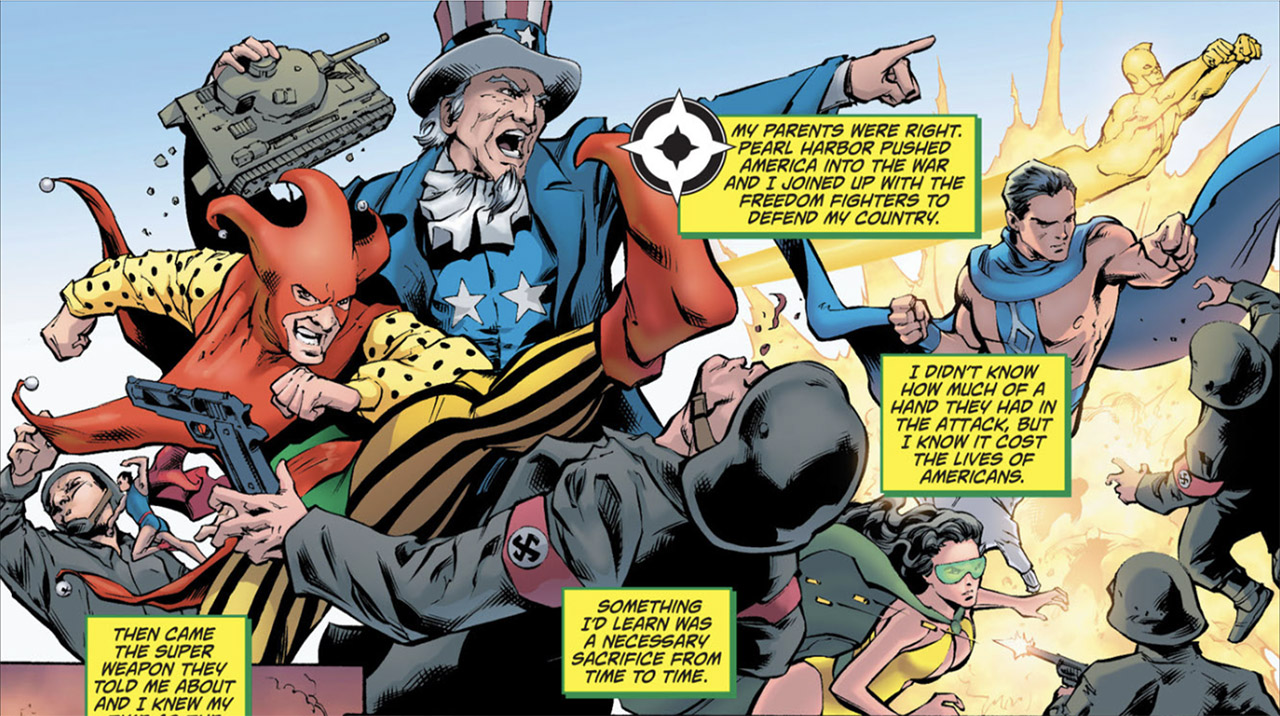

The Jester’s first DC Comics appearance was as a member of the All-Star Squadron. After Pearl Harbor, he decided to enlist his services with this group (All-Star Squadron #31) and participated in several of their missions. (#50, 60) He also joined the Freedom Fighters. (Freedom Fighters vol. 2 #4)
After the war, Lane threw himself into the service of the Arcadians. He married and had a son and daughter. This son was a dissenter among the Arcadians, and they killed him. Chuck raised his grandson, Charles, to one day exact their revenge. (Freedom Fighters vol. 2 #4)
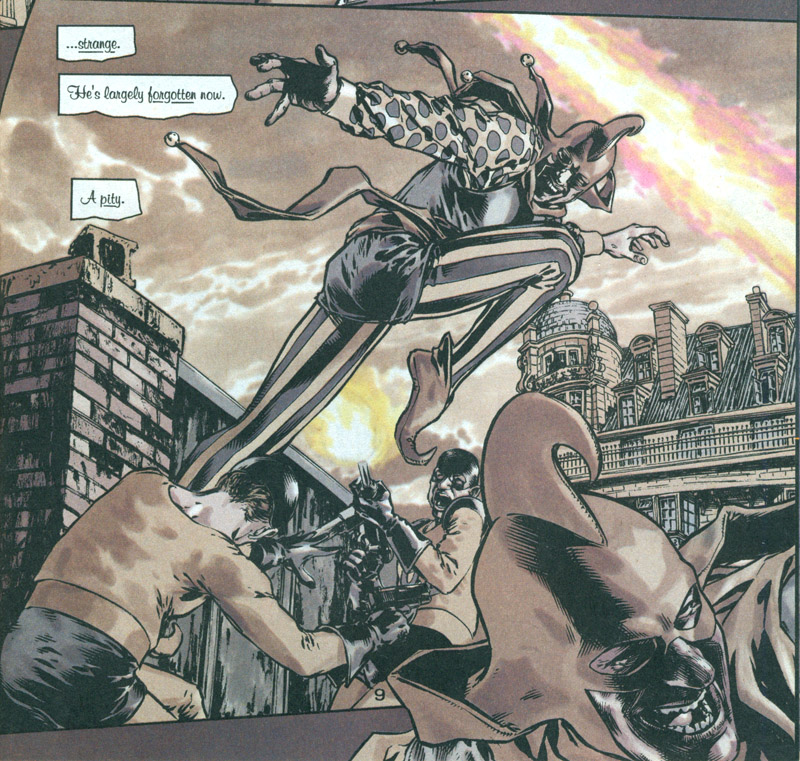
By 1954, Detective Chuck Lane had largely abandoned the guise of the Jester. His last known costumed adventure was one in which he pursued the criminal Bobo Benetti to Opal City. There Lane sought help from Starman. Their search was waylaid by a trio of villains (the Fiddler, Icicle and the Gambler), and Benetti gave them the slip. Soon Benetti was caught in another crime and he was extradited to Lane’s jurisdiction. (Starman vol. 2 #46)
Chuck Lane lived to a very old age and sacrificed his life as part of he and his grandson’s (Jester II) mission to take down the Arcadians. When agents of S.H.A.D.E. tracked him down, he blew them and himself up. (Freedom Fighters vol. 2 #5)
Notes

Paul Gustavson’s “Honeybun” strip in Police Comics #72 also featured a character dressed up in a red-and-green jester suit.
There have been a few other DC characters called the Jester, mostly take-offs from the popular Batman villain, the Joker. One of these goes all the way back to Batman #24 (Aug./Sept.1944). In a time travelling adventure, Batman and Robin visited ancient Rome and helped an aging charioteer win his last race and defeat a Roman gangster called Publius Malchio. A good-natured harlequin called the Jester —who looked startlingly like the Joker—aided them. This Jester's harlequin costume was thoroughly anachronistic, but the story left it deliberatelyk ambiguous, the question whether these events were real or simply a dream/hallucination induced by Dr. Carter Nichols' time-hypnosis technique. Thanks to Aaron Severson
In 2010, while the Joker character was "hands-off" to anyone but Grant Morrison, another Jester appeared. This one was probably a hallucination, the product of the troubled mind within Dr. Jeremiah Arkham. While he was running Arkham Asylum, the doctor "saw" a man who looked like the Joker but preferred to be called the Jester, the Joker's "evil twin." (Arkham Reborn#3, Feb. 2010) Eventually Dr. Arkham was himself found to be insane (Batman #697), and after his own confinement, he continuted to hallucinate this Jester. (Detective Comics #864, June 2010)Powers
The Jester had no metahuman powers. He was a crack marksman when it came to throwing his rubber accessory, Quinopolis. The weapon packed a powerful punch and somehow returned to sender. He exhibited above-average agility and strength.
Jester II
NAME + ALIASES:
Charles Lane II
KNOWN RELATIVES:
Charles “Chuck” Lane (Jester, grandfather), unnamed father and grandmother
(deceased), unnamed aunt
GROUP AFFILIATIONS:
The Arcadians
FIRST APPEARANCE:
Obscured: Freedom Fighters vol. 2 #1 (Nov.
2010) Fully revealed: Freedom Fighters vol. 2
#3 (Jan. 2011)
Jester II: Charles Lane II
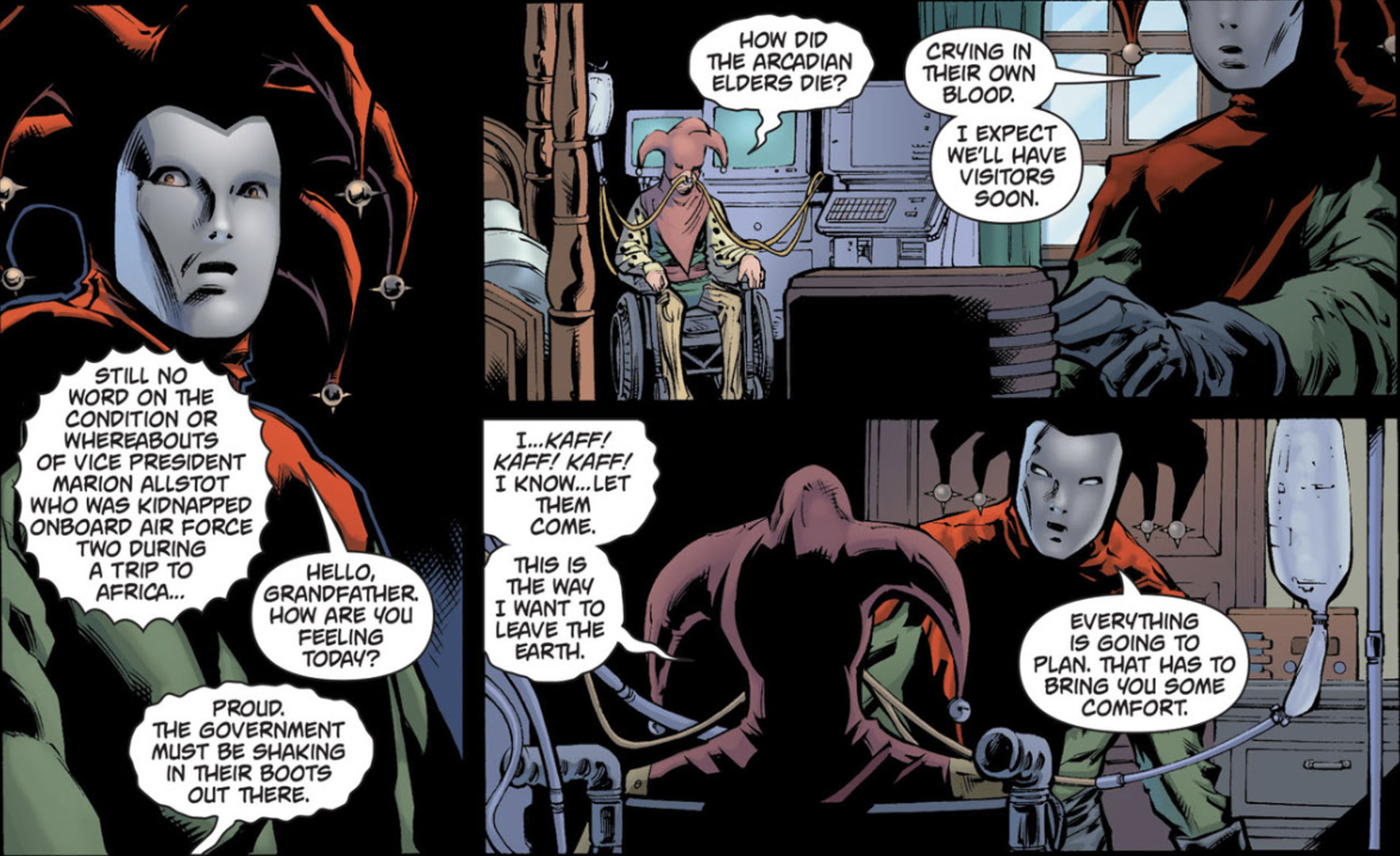
The Jester’s history was greatly embellished by Justin Gray and Jimmy Palmiotti in their 2010 Freedom Fighters series. Officer Chuck Lane’s Quality adventures remained in continuity, but a new backstory revealed that his family was descended from Walter Delane, the court jester to King Arthur. They were part of a secret society called the Arcadians, who helped found America and manipulated its progress.
On his death bed, Lane’s father advised him to police not only his city, but also his nation. He assured Chuck that America would win World War II thanks to a new weapon in development. Chuck interpreted his father’s advice by emulating other mystery men. (Freedom Fighters vol. 2 #4)
Lane's grandson was also named Charles Lane and he took up the mantle of the Jester (II). After the Arcadians murdered his father, this boy trained with his grandfather for revenge. The plan involved kidnapping the Vice President, Marion Allstot. He challenged the Freedom Fighters to collect a series of artifacts for him in exchange for her life. (Freedom Fighters v.2 #1)
This Jester revealed himself to the Freedom Fighters only when the team had managed to secure all the artifacts. But he was shocked to learn that Uncle Sam—the final necessary element in his plan—had been destroyed. The Jester killed Firebrand, which resurrected Uncle Sam. (#4-7) Sam managed to take down the Jester, removing and then crushing his powerful Helmet of War. (#8)
Powers
The second Jester had no metahuman powers but wielded three powerful Arcadian artifacts: the lantern of Paul Revere, the Helmet of War, and the sword, “Sherman’s Wrath.” Together, they provided near-limitless power.