

Midnight
Created by Jack Cole

NAME + ALIASES:
Dave
Clark
KNOWN RELATIVES:
None
GROUP AFFILIATIONS:
None
FIRST APPEARANCE:
Smash Comics #18 (January 1941)
Gabby: Smash Comics #21 (April 1941)
Dr. Wackey: Smash Comics #23 (June 1941)
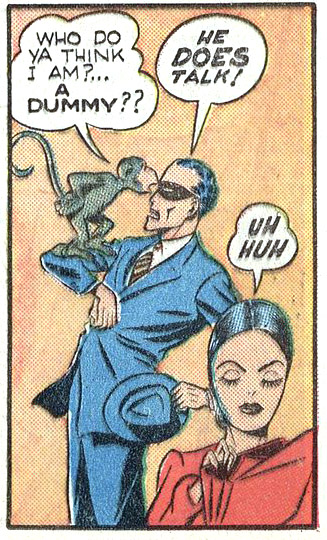
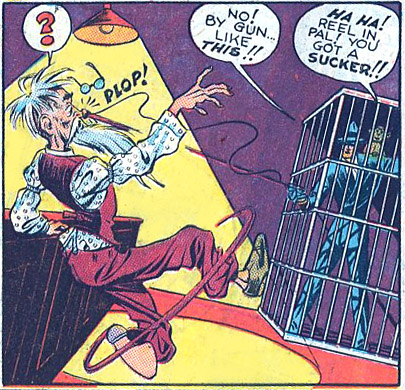
The Spirit was such an immediate success that Quality’s publisher, Busy Arnold, asked Jack Cole to create a Spirit knock-off. Cole wasn’t comfortable with that, so he spoke to the Spirit’s creator, Will Eisner. In an interview with Alter Ego, Eisner recalled the visit from Jack, who asked for his opinion. Eisner wasn’t thrilled but understood the situation. (Alter Ego #48) Despite this, Cole did create the copy, but did his best to make “Midnight” an entirely different kind of feature. Ironically, Jack Cole was one of the artists who produced “The Spirit” while Eisner was in the Army. Midnight was the perfect warm-up to Cole’s future blockbuster: Plastic Man. The character wasn’t the only Spirit copy; less successful Spirit-clones at Quality included the Mouthpiece and the Whistler. Lively storytelling and an appropriate amount of continuity helped give Cole’s strip the momentum to outlast most other super-heroes at Quality, and Cole’s own run on the feature. “Midnight” was published all the way into 1949 and was Smash Comics’ sole cover star beginning with issue #28 (Nov. 1941).
Dave Clark’s days as a mystery man
began in mid-1941, as a humble spot announcer for station UXAM (later XABC).
On his way home one evening, a building collapsed and Dave rushed to aid in
the recovery effort. He noticed that the building materials were shoddy, and
wasted no time taking up the matter with the building’s owner, Carleton. Clark
became the masked Midnight, a Robin Hood-esque hero who collected money from
the corrupt, and distributed it to the victims of the collapse. He failed to
ensnare Carleton, and was captured, then lashed to a crumbling dam. Clark was
anticipating his end when the dam cracked, freeing him. He managed to warn
the town below, but much damage was done. Midnight returned to Carleton’s house
to trounce him and his gang, then secured ten million dollars for the relief.
(Smash #18) Note: This origin story was faithfully
retold in DC's Secret Origins #28 (1988).
Before long, Midnight acquired his first sidekick (as the Spirit had). This was Gabby, a talking monkey who originally belonged to Miss Alice O’Day. O’Day gave animals the power of speech, and originally intended to give Gabby to the government. Thugs attacked and killed Alice, and burned her secrets, and Midnight gained custody of Gabby. This story also introduced Midnight’s primary weapon, the vacuum gun (a diagram of it can be found in Smash #23). It was an automatic that projected a suction cup connected to a self-winding reel of fine silk cord. It was strong enough to hold a man’s weight, and its suction held to almost any surface. (#21) Gabby became an integral part of Dave’s crime fighting career. When Dave went to work at the radio station, he set Gabby on a mission to expose two dueling milk companies that were endangering the public. Jack Cole’s talents were at full-strength in this tale; when Midnight was captured and the crooks attempted to unmask him, he protected his identity by making a nonstop series of funny faces until Gabby managed to free him. (#22)
In the next issue, the cast grew to include Dr. Mortimer Wackey (first name given in #32). Wackey was a foe who administered a pill that regressed people to infancy. He tricked Midnight into ingesting the drug, too. Gabby took a chance with the antidote—which might kill the subject—but Dave was restored. Instead of turning the doctor in, Midnight gave Wackey a chance to reform, working with him and Gabby to better promote his genius. (#23)
Dave’s social life suffered for his dual identity. For instance, when out with Miss Taylor, his attention wandered to busting up pickpockets. Doc and Gabby snuck in too, intent on testing Wackey’s new mind-reading invention. (#24) Wackey created many useful inventions, including the Visoscope, with which they could survey any part of the city. (#25) Dave was seen with another lady friend named Alice, who was, alas, the last woman he dated. (#26)
Midnight’s first “super-villain” was Chango the evil magician (#20), who on his second appearance kidnapped Gabby. Chango enticed people into his fortune telling shop, and hypnotized them into giving up their valuables. He was fairly powerful, able to pass through walls, and even transform Midnight into a dog! (#29) The Ghost of Robin Hood was the former millionaire, Mr. Mills, who targeted the rich to help the poor—namely, himself. He was a skillful archer who tagged Midnight in the back with a deadly arrow. (#27) The boys were attacked by the White Queen and her men in the Everglades. She was descended from a former slave shipmate who freed slaves, and founded a hidden community. They’d been apart from civilization for so long they didn’t know that slavery had been abolished. Midnight absconded with the Queen to show her this, and she returned to tell her tribe the news. (#33)
As with many of Quality’s lead features, Midnight’s antagonists alternated between costumed fiends and common mobsters. Prof. Craft attempted to take over city government with dupes made via plastic surgery. (#30) When Dave was assigned to broadcast from a movie premiere, he stumbled onto the murder of actress Joy Devine. Many of her associates died before Midnight found the killer. (#34)
Doc Wackey’s inventions fueled quite a number of plots, like the machine that changed atomic structure of matter. (#31) This was called the Atom Reviser, and Doc turned it over to the U.S. military for free. (#32) Prof. Porgie, an old pal of Wackey’s, afflicted the town with a formula that caused them to bounce like rubber. Meanwhile another potion turned Wackey back into a criminal. He and Porgie boarded a rocket bound for a distant planet made of gold. When they awoke, Wackey had regained his senses, and learned that they’d traveled around the Earth and landed back home. (#35)
When Midnight tumbled to his death from a battle with Cyclops Ceylon, Wackey declared him dead, and the city mourned. In the afterlife, Midnight was declined entrance to heaven, and chose Hades instead in order to take a crack at “the worst criminal of all,” the Devil. He was surprised to find that the true engineer to Hell’s agony was Satan’s wife, who subjected Midnight to unspeakable tortures. Meanwhile, a mysterious professor appeared to Doc Wackey, and offered to exchange his life for Midnight’s. The gambit worked, and the hero left Hell just as he’d convinced its inmates to revolt (and prevent further Nazi evils in the “waking world”). (#36) The next week, the stranger returned for Wackey’s life, and used Doc to create and test a super-speed formula. Midnight took the serum just to catch up with Doc, and eventually it wore off. (#37)
Jack Cole stopped signing the feature after Smash #36 (Oct. 1942) but the art in the next two issues looks like he had another inker (studio background man and inker Tony DiPreta snuck his name onto one story). Cole took a leave of absence from the feature, his last issue probably being #38, which featured Zor the Caveman. Zor was a mistreated oaf whom Midnight helped escape from the Dingling Brothah’s circus. There he uncovered more sad homemade freaks. At the end of the story, Dave received a letter from Two Face challenging him to a duel. The duel was slated for the next issue, but it never happened. (#38)
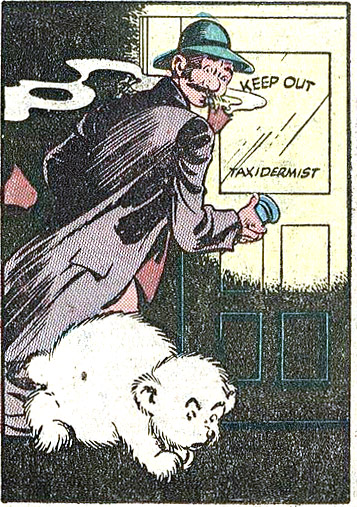
The torch was passed to Paul Gustavson, whose style is evident in the issues leading up to Smash #43, which was the first to bear his signature. Those first unsigned features by Gustavson reveal a vain attempt to emulate Cole’s work4. When Gustavson stopped trying to imitate Cole, he added two more recurring cast members, the bumbling detective Sniffer Snoop and his miniature polar bear pal, Hot-Foot. Snoop sought to mentor Midnight in detective work, but found himself in need of Midnight’s help. Dave took pity on Sniffer and Hot-Foot, and the two of them became permanent house guests. With Gabby and Hot-Foot, “Midnight” was now a borderline funny animal feature. (#42) Half a year later, Gustavson introduced Selwyn the meek, and his burly gal Gertrude. These were blatant copies of Hustace Throckmorton and Honeybun from “Human Bomb,” which Paul also created. Mercifully, they appeared only once. (#49)
Aside from this, Gustavson’s stories maintained the same relative wackiness. When Midnight plunged off a cliff, he found himself in a circus of the Land of Flight where he met Velvet, and Robustia the Queen of Flight. They sent him on his way in a rocket that disappeared once he was safely home. (#40) Professor Drizzpan engineered a hoax involving a “rocket from Mars” that unleashed a strange mechanical creature that destroyed homes with its death ray. (#48) Other colorful foes included the Laughing Killer (#56) and the dancing temptress, the Lorelei. (#62) Cyanide Cindy was a gun-toting beauty out for money the honest way—from a beauty contest. (#65)
Wackey was still on a roll, inventing a helium filled canoe for airborne escape, (#44) and a “time pill” that transported the gang to ancient Rome. Conveniently, a special vitamin in the pill also allowed them to speak the language. (#52) His friend, Professor Padsel demonstrated the ability to switch the minds of individuals. (#61)
Things were always eventful at the radio station. When Dave voiced the latest installment of “The Mask”—the day’s most popular adventure—a real life Mask appeared, and murdered several of the crew before Midnight could stop him. (#43) Lady mob boss Darla Dee dropped in on Dave to announce her takeover of the city. When he refused to lead her to Midnight, she framed him for murder. (#53) When Dave promoted the engagement of two of the station’s biggest stars, Thrush and Swooner, jealous fans came out of the woodwork, and one of them was poisoned to death! (#60)
Jack Cole returned to his creation with issue #68, and kept Gustavson’s additions. Most of these issues were unsigned, which had become the norm in features during the middle of the war. Cole managed to sneak his signature onto Smash #82-83, however, and the art in that issue matches the art from #68 on. One of the livelier tales followed the gang to a lighthouse, from which Clark’s radio program was broadcasting. It was complete with a lost treasure and the death of the lighthouse keeper. (#71) Another adventure echoed Cole’s other creation, “The Barker,” when Midnight went to the fair and protected a prize cow named Angela. (#72) They weren’t done with bovines: Hotfoot the bear squared off against a bull in the stock market. The raging animal was calmed after his master, a disgruntled investor, was uncovered. (#73)
A trio of tales had that “olde tyme” flavor. Dave’s boss was obsessed with thinking up new ways to improve the station’s ratings, and offered $5000 for the oldest man in the world. When a 200-year-old Revolutionary war vet stepped forward, he was shot by the descendant of a Redcoat. (#75) Another introduced Willie the Kid, a bad old man of the Wild West. (#81) Woodland Boy was a mesmerizing flutist who was victimized by Song Thief Danny, who tricked him into signing away the rights to his song. (#82)
Wackey and Snoop were kidnapped by Professor Hangnail for a supposed trip to Mars, which was actually a ploy to generate public hysteria while his gang looted the town dressed like aliens. (#79)
In his last adventure, Dave Clark’s career took a promising turn towards television. It began with Midnight’s move to protect the radio station’s most popular singer, Peggy, who was being swindled by her agent, Percentage Graftly. Graftly retaliated by hiring a hillbilly hag whom he hoped would ruin Dave’s first television show. The hag’s suitors caused such a ruckus on air that the show was a hit! The next day, the newspapers lauded Clark’s success. (#85)
DC
The classic Midnight has only appeared in DC Comics a couple of times. On the eve of the attacks on Pearl Harbor, Midnight was tracking the hero known as Uncle Sam. En route, he encountered the Doll Man, who was on the same mission. They were too late, but just before Uncle Sam departed, both Midnight and the Doll Man dove into Sam’s tele-portal. Instead of materializing near Pearl Harbor, they were transported to occupied France, where they joined Mademoiselle Marie in the French resistance for several months. They intercepted a message concerning a second Japanese attack on Santa Barbara, California, but before they could act, they ran afoul of the evil Baron Blitzkrieg. As fate would have it, Uncle Sam’s portal appeared again just as the Baron blasted Doll Man. Midnight carried his partner through it to New York City, and barely made it to the All-Stars’ meeting in the Perisphere. Midnight was more than willing to keep fighting, but Dr. Mid-Nite hospitalized him instead. (All-Star Squadron #32) After this, Midnight was not known to be active with the All-Stars or Uncle Sam’s group, the Freedom Fighters.
Notes
On the splash page of Smash #36, Gabby announced that the feature was expanded to nine pages, like the readers “asked for” (although it had already done so the issue prior).
Fiction House also published a feature called “Midnight” about a black stallion, in Jumbo Comics.
Midnight was the inspiration for a character of the same name in John Arcudi’s 2002 Elseworlds series, JLA: Destiny. This character’s name was William Cole, in homage to Dave Clark’s creator, Jack.
Powers
Midnight had no super-powers, but frequently used a vacuum gun. This automatic weapon projected a strong suction cup that could adhere to any surface, and was connected to a super-strong silk cord. He also had a wrist radio to communicate with his helpers. Doc Wackey invented many other devices that helped on cases as needed. Midnight wore a reversible suit: blue during the day and black as the “midnight sky” when he was masked.
Midnight II
NAME + ALIASES: Robert Mason/Robert Avery
FIRST APPEARANCE: Ms. Tree Quarterly #1 (Summer 1990)
Midnight II
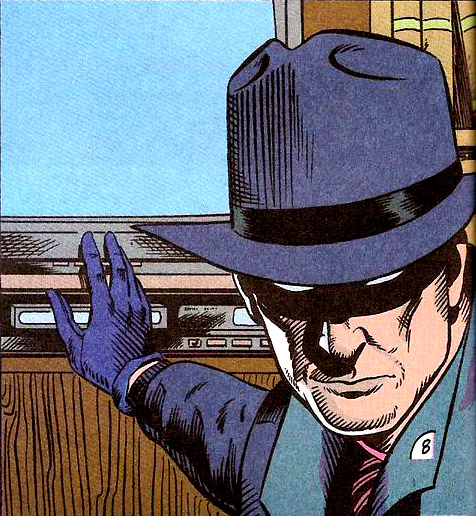
Midnight was reinvented in DC’s Ms. Tree series. This back-up feature was “of its time,” depicting a somewhat grim and ruthless vigilante. This Midnight was perfectly willing to kill if he thought it was justified. Midnight operated from St. Michael’s church, where troubled citizens would light a candle for help, at midnight. If he agreed to take their case, he would appear the following night and hand them his clock-faced calling card—but he never spoke. He didn’t wear a mask, but his fedora cast a mask-like shadow over his eyes. His uniform was less formal than his predecessor: dark casual jacket, pants and gloves, and a striped tie. (Ms. Tree Quarterly #1)
In issue #4, he was identified as the red-haired, 35-year-old private detective Robert Avery. (The last name was changed to Mason in #6.) He fell for a client named Claire Reynard, only to discover that she was a con artist, Sarah Todd. Still, he turned her over to authorities, and she was convicted of murder, and executed.
Powers
This Midnight never exhibited any super-human powers, nor did he use any special weaponry.