

Mr. Mystic
Created by Will Eisner and Bob Powell

NAME + ALIASES:
Ken (last name unrevealed)
FIRST APPEARANCE:
The Spirit Section, 2 June 1940
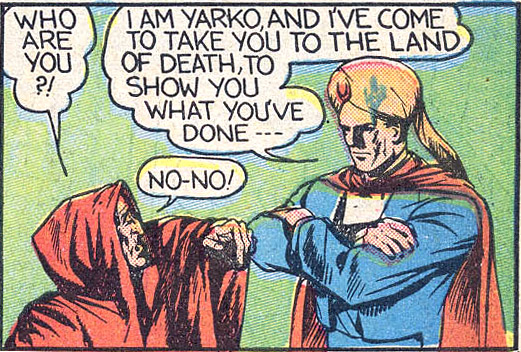
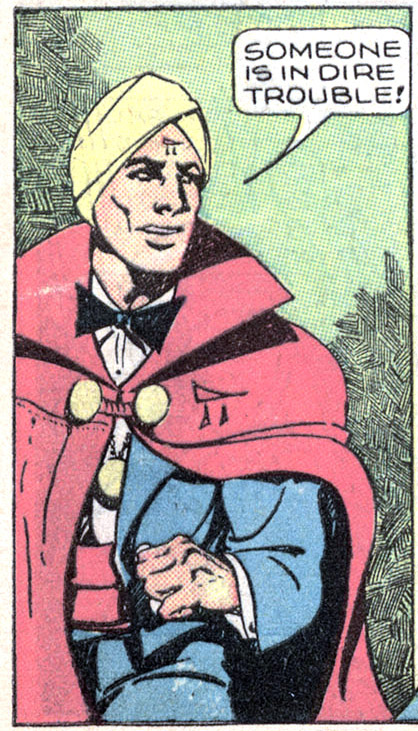
Mr. Mystic followed in the footsteps of Will Eisner and Bob Powell’s Yarko the Great, published by Fox in Wonder Comics #2 (1939). Both heroes wore yellow turbans, red capes and tuxedos. Yarko was most likely inspired by Mandrake, a popular turbaned magician that was syndicated in newspapers starting in 1934.
“Yarko” was prepared at the Eisner & Iger studio, but when Will Eisner separated from Iger to create his new Sunday Spirit Section, Powell moved with him. They retooled Yarko as “Mr. Mystic.” Powell’s last Yarko feature was Wonderworld Comics #10 (Feb. 1940), and Mr. Mystic debuted on June 2, 1940. Yarko continued through Wonderworld #33, so the two were published simultaneously for a time. (DC had a similar hero, Sargon the Sorcerer, who first appeared in All-American Comics #26, May 1941.)
According to Will Eisner, Mr. Mystic’s paramours were reflections of those in Bob Powell’s own life. When Powell got married, Mr. Mystic also settled, on the lovely Penny. (These details come via Cat Yronwode, in Will Eisner Presents, 1990.)
“Mr. Mystic” appeared in five pages every week as the last of the three features in the Spirit Section. Along with the Spirit and Lady Luck, the character has always been under the copyright of Will Eisner. According to Eisner, Bob Powell wrote and drew Mr. Mystic himself. (Alter Ego #48)
Mr. Mystic’s war against evil began in “a tiny country in the path of an invader.” This land was ostensibly Tibet, where American diplomats were forced to flee from Asian aggressors. One of them, a man named Ken, selflessly gave up his seat on the plane to an important scientist. Ken hopped another abandoned plane and attempted to fly to safety, but he was shot down in the Himalayas. This was his fate, preordained by a council of seven lamas (spiritual masters). These monks retrieved Ken from the wreckage and transformed him. Before he could learn much more, the lamas ascended to the clouds. Ken stood stranded and confused when a voice boomed from above and declared that henceforth he would be called Mr. Mystic. He became magically attired in a turban, cape and tuxedo and with his slightest wish, his broken plane was repaired! His forehead was now emblazoned with an arcane symbol (which resembled the “pi” symbol). His new powers were limitless, and he wasted no time in ousting the European invaders. (Spirit Section 6/2/1940)
Only another strong mystic could truly match Mr. Mystic’s powers. In Arabia, he stood for hours on the desert sands locked in mystical battle with an old fakir, Kabula. (6/16/40) But his most formidable foe might have been a femme fatale named Eléna, an Axis agent with a thirst for magical power.
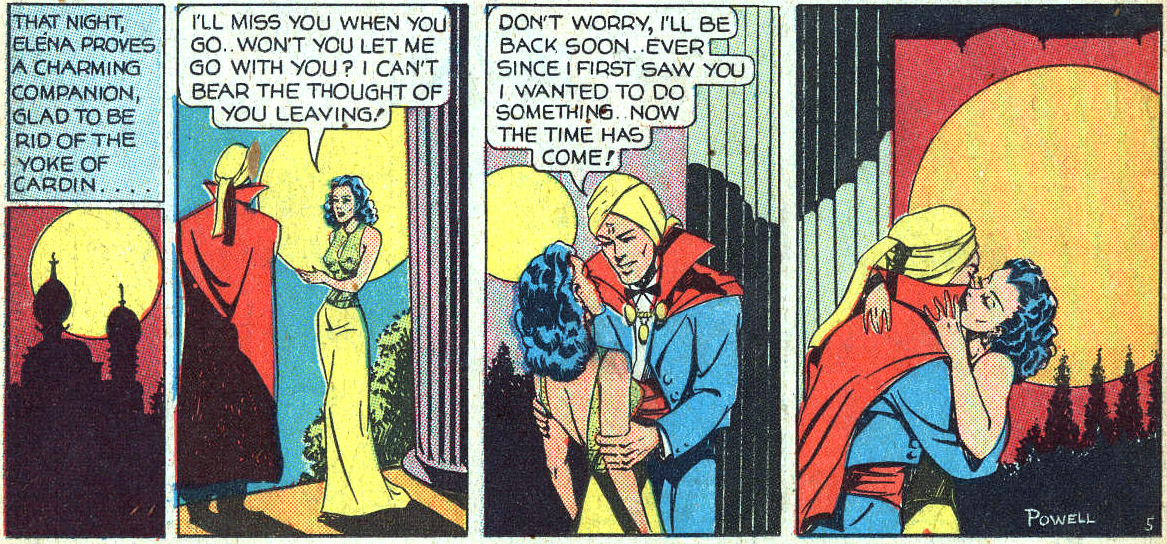
Eléna was a wily fascist who first demonstrated only the powers of hypnosis and marksmanship. Mystic was charmed by this woman, who returned many times. (6/9/40) Next time, she made a grab for Mr. Mystic’s new necklace, which was a gift from the lamas that made his power “supreme.” (6/23/40) Eléna soon secured magical power of her own that was granted by “Cardin the Terrible.” It came with one caveat: if she were ever defeated in a duel, the power would be withdrawn. With the playing field leveled, Mr. Mystic indeed proved that he was superior. Minus her powers, Eléna reverted to the form of a little girl. Easily fixed—Mr. Mystic restored her womanhood with a gesture so that the two of them could finally be together. (7/21-28/1940) The couple was soon engaged to marry and when she was kidnapped by Sarku, Mystic sensed her peril and followed his foe into the future. There Sarku had teamed with Tan Tan, the king of the moon. (9/1/1940) He also saved her from the ghost of Don Juan De Leon. (12/15/1940)
As his reputation grew, others began to seek out the aide of Mr. Mystic, including the U.S. military. The onset of war brought a sometimes lighter tone and cases involving Axis intrigue (but still punctuated by fanciful tales and ancient alchemy).
According to his ex-wife, Bob Powell entered the Army Air Corps in 1942, but his work appeared on “Mr. Mystic” into 1943. Perhaps he was able to work on the feature while in training. Fred Guardineer took over the strip until its end. Before this, Guardineer had drawn the magicians Merlin and Tor for Quality, and Zatara for DC. Guardineer’s stories shifted to a more mundane, two-fisted approach, and Mr. Mystic was discontinued about a year later. In May 1944, it was replaced by “Intellectual Amos.”
In comparison with some of his 1940s contemporaries, Bob Powell’s art might not be considered the “tops,” but he was more than adept at creating compelling stories and exotic scenes. Mr. Mystic himself was a bit stiff (his formal attire allowed Powell to eschew detailed anatomical drawing) but his female co-stars were a lively mix—from girls-next-door, to foreign temptresses, to stern officers.
Notes
Unlike the Spirit and Lady Luck, Quality did not reprint Mr. Mystic’s adventures in its monthly titles. The first five Mr. Mystic adventures were reprinted in black-and-white by Eclipse in one volume of Will Eisner Presents (1990). Some of the features were reprinted in Kitchen Sink’s Spirit Magazine. More appear in IDW’s trade paperback John Law: Dead Man Walking (2004).
Powers
Mr. Mystic’s vast powers included teleportation, astral projection, control over the elements, physical transformations of all sorts—any fantastical feat, really. The powers were partly derived from amulets, or “luck charms,” worn as necklaces or on his cape.