

Phantom Lady
Sandra Knight created by Arthur Peddy

Phantom Lady I
NAME + ALIASES:
Sandra Knight
KNOWN RELATIVES:
Harold Henry Knight (father, deceased),
Arnold “Iron” Munro (ex-husband), unnamed son (deceased), Walter
Pratt (son, deceased), Katherine Spencer (Manhunter VII, granddaughter),
Ramsey Robinson (great-grandson), Priscilla (aunt), Ted
Knight (Starman I, cousin, deceased), Jack
Knight (cousin, Starman VI)
GROUP AFFILIATIONS:
All-Star Squadron, Freedom Fighters
FIRST APPEARANCE:
Police Comics
#1 (August 1941)
APPEARANCES:
- All-Star Squadron #2-4, 25 41, 44
- All-Star 80-Page Giant #1
- Birds of Prey vol. 2 #14-15
- Damage #6, 11, 12
- Feature Comics #69-71
- Freedom Fighters #1-15
- Justice League of America #107-108
- Police Comics #1-23 (August 1941–Oct. 1943)
- Starman v.2 #44, 73
Fox:
- All Top Comics #8-17 (November 1947–May 1949)
- Phantom Lady #13-23 (August 1947–April 1949)
Ajax:
- Phantom Lady #1-4 (December 1954–June 1955)
The Original Phantom Lady (Quality Comics)

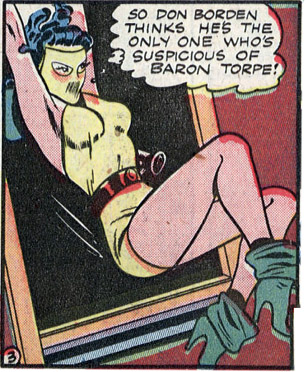

Given her historical popularity, it’s surprising to find that Phantom Lady’s early appearances in Police Comics suffered from rather poor scripts and characterization (but rather nice artwork by Arthur Peddy). Frank Borth drew her adventures beginning with Police #17, and he added the famous split-top to her costume. (Her Quality contemporary, Wildfire, wore a much skimpier top!) Borth also engineered P.L.’s crossover with his other creations, Spider Widow and the Raven. This crossover is one of the few examples of such in Quality Comics. Both of Borth’s features ended around the same time, which undoubtedly coincided with his enlistment in the army.
Sandra Knight’s Quality and DC continuities marry fairly well. Her origin was first retold in Freedom Fighters #15 (July-Aug. 1978). But the story from 1985’s All-Star Squadron #41 added two major things: the assertion that she aided in developing her black light gun, and that she was related to Ted Knight (Starman).
Sandra Knight was the debutante daughter of Senator Harold Henry Knight. Known for her social activities, she hid the fact that she was actually a quite brilliant scientist. Sandra worked with Prof. Abraham Davis, whose inventions would one day supply the technology behind her “blackout” wristbands. But before that, Sandra was instrumental in jump-starting another mystery man’s career—her cousin, Ted Knight’s. She introduced Ted to Prof. Davis, who helped him perfect Ted’s “gravity rod” technology. The device channelled energy from the stars for various uses. Ted eventually used the rod to become the original Starman. (All-Star Squadron #41)
In mid-1941, Sandra made her own foray into crime fighting (albeit out of costume), saving her father from a would-be attacker. In this instance, the attackers marveled at the presence of some “phantom lady,” a name which she also uttered to her father before receding into the darkness. (Freedom Fighters #15) This prompted her to adopt an alter ego.
By day, the young socialite put on a bored front. But now she was ready for danger. She first donned her costume on a trip with her father to a bomb testing site. When they arrived, they found the field under attack by a U.S. navy plane. A man named Wenner had kidnapped Dr. Raphael’s bomb and escaped in the plane. Sandra took to the night as the Phantom Lady to investigate and unveiled her sole weapon: a “blacklight lantern” that emitted a cone of nulled light. Her car was also equipped with the black rays, used to disguise her escape. She found a remote hideout where she narrowly rescued Raphael and his bomb formula, which he decided to give to the War Department. Later, Sandra dined with her beau, Don Borden, who was a State Department Investigator. (Police #1)
When an attack on the embassy of the nation called Herma threatened to drag the U.S. into Europe’s war, Sandra devised a clever plan to catch the perpetrators. She took her father’s oriental antiques to a dealer to sell them, which flushed out the Oriental saboteurs (who stole them). The dealer recognized the men and led Phantom Lady to their lair—the embassy of Herma’s rival nation. The mastermind turned out to be an American man convicted of treason. Sandra freed the Hermese ambassador and persuaded him not to declare war on the U.S. (#2)
Both Don and Senator Knight were targets for attack. Sandra magically managed to locate Don’s kidnappers after being knocked unconscious herself. At a remote hideaway she freed him. Somehow, though she didn’t wear a mask, Don didn’t recognize Phantom Lady as his girlfriend. (#3) Don was jealous when the Paradoran Captain Ortega took notice of Sandra. He took the Paradoran ambassador’s daughter to the ball that night. Naturally, it turned out that Ortega was secretly a Fifth Columnist. (#5)
Murder at a costume ball led to crooks at the zoo. Phantom Lady showed no hesitation in shooting one of them and another was left to be eaten by a lion! (#7)
When Sandra learned that Japanese nationals were planning to kill her father, the Phantom Lady completely botched an attempt to save him. Instead of alerting authorities, she got herself kidnapped then failed to prevent the Japanese from shooting the Senator on the Senate floor. Luckily the wound wasn’t fatal and she caught the shooter while he was fleeing. (#9)
Her friend Maisie became an occasional guest-star. (#12) When Sandra failed to turn up for a social function, Maisie and Don located her and fell prey to an impostor Phantom Lady. Sandra got lucky and freed herself, then her pals. (#13)
Her only other known relative was her aunt Priscilla whom she visited in West Point. Priscilla discovered her dual identity but Sandra got out of it with some quick talking. (#14)
After infiltrating the School for Spies, run by Baron Torpe, Phantom Lady finally realized that a mask would be beneficial to her crime fighting career and she wore a silk drape over her face. (#15)
The Borth Era
When Frank Borth took the helm on Phantom Lady’s adventures, he dispensed with Sandra’s new mask, but a domino mask appeared in Police #18, and was gone again the next issue. He also began a multipart adventure that crossed over with his other Quality feature, the Spider Widow. That case began with a series of attacks by an unseen mob boss on the life of Sandra’s father, at a party in the Senator’s home. (Police Comics #17) Another spy attacked the Senator while dressed as the Easter bunny. (#18) After the next attack, it became clear to Sandra that she’d have to be more proactive in finding the man behind these attacks. They struck again while she was boating with her friends Jake (a comic strip artist) and Heidi on Lake Erie. Sandra took to the aquaplane (a platform for waterskiing) and was overtaken by men bent on revenge against her father. She stealthily donned her costume and commandeered another boat to round them up. (#19)
Sandra was soon contacted by another mystery man, the Raven, who informed her of her father’s capture. His note led her to the docks where Phantom Lady found that the Raven had also been captured. She freed the hero, then her father, and quickly ditched the Raven in order to usher her father to safety. The crooks escaped. (#20)
During the course of this caper, the Raven must have deduced the Phantom Lady’s dual identity, and he contacted Sandra, wanting to introduce her to his crime-fighting partner, the Spider Widow. Dianne was immediately jealous of Sandra and the two began to bicker. Raven maintained a tenuous peace and the three determined to find Senator Knight’s tormentors once and for all. They hopped the subway (yep) on the trail of one of the gangsters whom Raven had recognized. Even amid danger the two women quibbled; the Spider Widow was angered that Phantom Lady was stealing the show. (Feature #69)
Both heroines soon received notes that challenged the other to a duel—and neither hesitated to accept. The Raven would officiate. But the duel was orchestrated by their true quarry, who had hoped to kill three birds with one stone. As a bonus, the crooks discovered that the women were dueling without their masks on, and their identities were compromised. At the first sign of gunfire, the heroes dove to safety. The Raven took a slug to the back but Sandra and Dianne mopped up the gunmen. They sped him off to the hospital where, true to form, the women reverted to arguing over who would look after him. (Police #21)
Despite their disdain for one another, the partnership continued. The Raven infiltrated the crime ring they’d been trailing and fingered its boss, Larkin. Larkin intended to disguise himself as Senator Knight. At last the trio took him down, but before he could be brought to justice, he was killed by one of his own gang’s bullets. (Feature #70) In their last adventure together, the Raven attempted to mend relations between the girls. His prank, however, turned sour when mobsters intervened and captured him and Phantom Lady. After one timely rescue by the Spider Widow, the gals became pals. (#71)
After bidding adieu to her partners against crime, Sandra returned to safeguarding Washington D.C. at the launch of a new “super” submarine. (#22) Phantom Lady’s own career began to jeopardize her father’s life. When paranoid mental patients broke free from their confinement, they headed for the home of Senator Knight and tied up all the staff! (#23)
That’s all they wrote for the Phantom Lady at Quality Comics. Her original features lasted barely two years, but her legend continued to grow beyond it…
Phantom Lady After Quality
In 1947—four years after exiting Quality Comics, and just as long after the decline of the super-hero— Jerry Iger resurrected “Phantom Lady” for Fox Features Syndicate. There’s sufficient evidence to place Phantom Lady’s creation within Iger’s comic book features studio. By the time Police Comics #1 was launched, his original partnership with Will Eisner had dissolved, but both Phantom Lady's artists (Arthur Peddy and Frank Borth) are known Iger employees at that time. What is less clear is whether Phantom Lady was produced by Iger for Quality directly, or whether she was part of the package that Will Eisner subcontracted to Iger after their partnership ended (which Eisner admitted to doing).
This begs the question: Was the character owned by Quality under the assumption of work-for-hire? If so, why was Iger allowed to republish her? The simplest conclusion is that, regardless of copyright, Quality’s publisher, Busy Arnold, didn’t care. By 1947, Quality had moved away from super-heroes.
It's a curious decision, choosing the short-lived Phantom Lady for a relaunch. But in doing so, Phantom Lady became a cult icon due to her appearances in Fox comics — and to the artist who reinvented her: Matt Baker (under the pen name “Gregory Page”). Baker’s style is now synonymous with “Good Girl Art”— ostensibly good girls who are suggestively illustrated in revealing attire.
Baker’s Phantom Lady was based on Quality’s; this Sandra Knight was also the daughter of Senator Wright. Her costume was was retooled slightly for All-Top Comics, recolored dark blue and red. The black light ray was back, and so was Don Borden. These pre-Comics Code adventures were well written and liberally adorned with lovely ladies. The covers are curiously repetitive, though, nearly identical in some cases. After appearing in All Top Comics #8–17 (1947–1949), Phantom Lady starred in her first self-titled series for 11 issues (1947–1949; which picked up issue numbering from a humor comic, Wotalife).
In 1954, Iger revived her once more at Ajax/Farrell, which published four issues of a second Phantom Lady series. This character was like the one published by Fox. The nascent Comics Code’s seal appears on issue #3, and inside, her skirt became more like (short) shorts. In issue #4, the shorts were lengthened significantly.
The blue-and-red version of Phantom Lady has never appeared in DC’s comics. But that’s not to say DC hasn’t laid claim to that version of the character… sort of (read next).
The Copyright to Phantom Lady
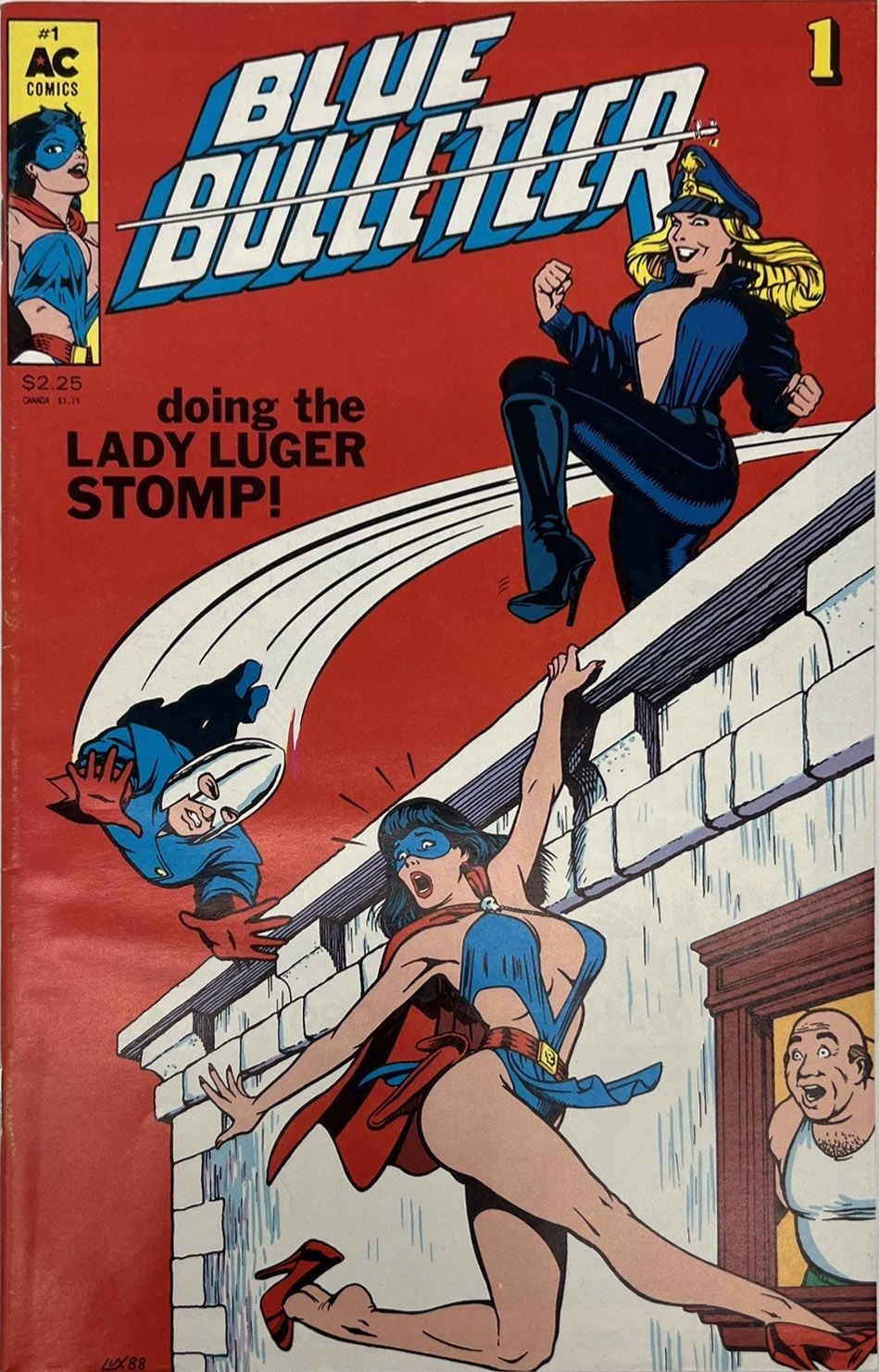
DC has asserted its trademark rights to Quality characters. In particular, there was a case involving one independent publisher’s attempts to use Phantom Lady. Bill Black, of AC Comics, was a longtime fan of Golden Age heroes when he published Captain Paragon #1 in 1972. This black-and-white book featured a one-page pin-up of Phantom Lady and a four-page original story. Black’s Phantom Lady sported the costume used in her Fox/Ajax incarnations. His early issues of Fem Fantastique also featured Phantom Lady. In 1978, Black published a third issue of Fem Fantastique, which was not so much a comic book as a “fanzine.” This issue even featured specially-commissioned art by industry greats, including a cover by Dick Giordano featuring Lady Luck, Sheena and Wonder Woman. Fan-oriented publications and periodicals are routinely allowed more leeway for this sort of usage.
In 1981, Black took a step towards what would become his most successful series, Fem Force. As before, he drew inspiration from the super-heroines he’d read as a kid. He produced Femzine #1, which was anchored by Miss Victory, a former Holyoke character now in the public domain. Her team, the “Femme Force One,” included the Blonde Bomber (from Harvey’s Green Hornet Comics), some original creations, and Phantom Lady. Since he’d been using Phantom Lady since 1972, it probably never occurred to Black that this would be an infringement. Regardless of precedence, Black was asked by DC’s editor, Dick Giordano (who’d previously drawn Phantom Lady for Fem Fantastique) to “cease and desist.” After that, AC’s character was renamed and redesigned, eventually becoming Laura Wright aka “Nightveil,” with new costume (whose alter ego was also the daughter of a senator).
The character was then renamed the Blue Bulleteer in her 'postwar' adventures. (Femforce-Femfans)
DC Comics
Phantom Lady appeared at DC Comics in 1973’s Justice League of America #107-108. Sandra was reintroduced to readers wearing her original Quality uniform along with other former Quality heroes, as the Freedom Fighters. This story and the successive Freedom Fighters series are no longer in DC continuity
Dialing back the “continuity clock” just a bit, Phantom Lady’s current DC continuity picks up with World War II. In 1981, Roy Thomas created the All-Star Squadron, a World War II era super-group. He cast Phantom Lady as a primary character, and picked up her story (more-or-less) where her Quality adventures left off…
Sandra was in her home in San Francisco on Dec. 7, 1941, when air raid sirens began to blare in response to the Japanese attack on Pearl Harbor. As fate would have it, the newly formed All-Star Squadron was also in town and she joined them in battle against Per Degaton. By this time, Phantom Lady had realized that wearing a mask was more effective than blinding everyone with black light. She was present in San Francisco with her father, the Senator, when Per Degaton’s group of villains attacked the All-Stars, of which she became a founding member. (All-Star Squadron #2) After this mission, she returned home to check on her father, but re-teamed with the Squadron frequently throughout the war. (#4)
Sandra made considerable upgrades to her equipment. Her new goggles enabled her to see amid her own darkness, and she also developed a way to internalize the power of her gun. By doing so she could make herself invisible. It came in handy when she and the All-Stars were attacked by the time-tossed Infinity, Inc. (#25-26)
When the All-Star Squadron expanded, they held an open call at their new headquarters in the Perisphere, in New York. There Sandra met Uncle Sam and joined his splinter group, the Freedom Fighters, who stopped Baron Blitzkrieg’s invasion of Santa Barbara, California. (#31-35) Also during this mission, the Phantom Lady lent the use of her black light ray to activate the Miraclo residue in Hourman’s body. (#35)
For the remainder of the war, Phantom Lady remained with the Freedom Fighters, which separated from the All-Star Squadron and were based in Washington DC to keep closer ties to the White House. (Who’s Who ‘87 #5) Sandra even teamed with her cousin, Starman (Ted Knight), to battle the Prairie Witch in Opal City. (Starman vol. 2 #44)
After the War, Sandra met her first husband, the young powerhouse known as Iron (Arn) Munro. Before the two of them were married, Sandra conceived a child—which she never revealed to him. She confided only in the Atom (Al Pratt) who helped her put the child up for adoption. The hospital mistakenly put Al’s name as father on the child’s birth certificate and the child was named Walter Pratt. (Manhunter vol. 3 #23)
In the 1960s, both Sandra and Arn joined a new branch of the O.S.S., a spy agency called Argent. As Sandra put it, they “became lovers, then married on the spur of the moment, while vacationing in Monaco—and quarrelled every day for a month after.” Their union was indeed cursed. She undertook a fateful mission to Poland to hunt down Baron Blitzkrieg and his psionic ally, Kodrescu. Phantom Lady walked into a trap, and only then learned that she was pregnant with her second child. The Baron stole her child and left her to die.
When she escaped, she returned and sought the help of the Human Bomb, who hooked her up with Sarge Steel of the CBI agency. She formed her own intelligence academy called the Université Notre Dame des Ombres (“Our lady of the shadows”), in France. Sandra hoped this new network would help find her child, but to no avail. Still, the school trained promising young students in the covert arts. Iron Munro presumed she was dead, and she did not contact him. The fate of their second child is unknown. (Damage #11)
Legacies
Sandra’s first child—Walter Pratt, whom she’d given up for adoption—grew into a homicidal maniac. Because of the false information on Pratt’s birth certificate, the public believed that he was the son of the original Atom. Pratt murdered the mother of his child, a woman named Lydia. Their daughter (Sandra’s granddaughter) Katherine Spencer later became Los Angeles’ Manhunter and wound up battling Walter Pratt. After Pratt’s death (he was cut in half midstream in teleportation [Manhunter #19]), Spencer learned her true lineage from the Justice Society’s Dr. Mid-Nite and paid a visit to her grandmother, Sandra Knight. (#23) Kate also has a son, Ramsey Robinson. Sandra and Iron Munro have since reestablished an easy friendship and are helping to raise Ramsey. (#33-34)
Notes
The Super DC Calendar 1976 gave Phantom Lady's birthday as January 7.
Sandra’s father’s name was first told as Harold “H.” Knight in Police #20. Later stories dubbed him “Henry” Knight, which we take to be his middle name.
Argent, the covert agency that Sandra was said to have joined in Damage, and its leader, Control, first appeared in DC’s G.I. Combat #192. Ironically this was a title that moved from Quality to DC. It was a division of Task Force X which also spawned the Suicide Squad.
Phantom Lady is also the title of a 1942 novel by Cornell Woolrich which was adapted into a film in 1944.
Powers
Sandra Knight originally had no innate superhuman abilities, but practiced martial arts such as jujutsu. She was also nimble as an acrobat. She relied on her original “black-out” wristbands which created a field of darkness. The bands were eventually altered to also render her invisible under normal light. She later developed goggles that allowed her to see amidst her black-out rays.
Appearances + References
» FEATURED APPEARANCES:
- All-Star Squadron #2-4, 25 41, 44
- All-Star 80-Page Giant #1
- Birds of Prey vol. 2 #14-15
- Damage #6, 11, 12
- Feature Comics #69–71
- Justice League of America #107–108
- Starman vol. 2 #44, 73
» SERIES:
- Police Comics #1–23 (Aug. 1941–Oct. 1943)
- Freedom Fighters #1–15
Fox:
- All Top Comics #8-17 (Nov. 1947–May 1949)
- Phantom Lady vol. 1 #13-23 (Aug. 1947–April 1949)
Ajax:
- Phantom Lady vol. 2 #1–4 (Dec. 1954–June 1955)
» SEE ALSO:

Phantom Lady II
NAME + ALIASES:
Delilah "Dee" Tyler
KNOWN RELATIVES:
Albert A. Tyler (father), Diana (deceased), Beau Tyler
(uncle)
GROUP AFFILIATIONS:
Freedom Fighters
FIRST APPEARANCE:
Action Comics Weekly #636 (January 1989)
Phantom Lady II: Delilah “Dee” Tyler
Created by Len Strazewski and Chuck Austen

Sandra Knight’s star pupil at the Université Notre Dame des Ombres was Delilah “Dee” Tyler, whom she awarded Phantom Lady’s costume and equipment. (Action Comics Weekly #636) The equipment was upgraded to include a wrist-mounted laser blaster, and a holographic projector that could be used to create convincing illusions. The projector was worn like an amulet at the convergence of her cape. Dee was also an expert in the martial art called “savate” (French kickboxing).
Dee’s mother Diana had also been a member of the Université. Diana met Dee’s father Albert A. Tyler there in France, when he was in the Navy. Although the two seemed mismatched, they were soon married and returned to New York City, where she helped guide his political career. Diana passed away when Dee was still young. (Action #641)
After her own graduation from the Université (officiated by Dean Sandra Knight), Dee returned home to Washington D.C. where she set up an apartment near her father. Like Sandra’s father, Albert had become a high ranking U.S. official. But Dee sensed something was wrong about Albert. A bit of digging on her part uncovered the fact that he was being blackmailed by Edwin Guerrehart. (Action #636)
Guerrehart was the head of the international crime cartel called Les Mille Yeux (“thousand eyes”). He was bold enough to even try to kidnap the Vice President. Phantom Lady was just in time (with her father’s gun-toting aide, Roger Richter) to save him. (#638)
They sneaked into Guerrehart’s costume ball and uncovered more clues about the blackmail afoot, but they had to flee when her father was injured in the ensuing fight. (#639) She returned and saw the photos in question, which showed her father with the Ku Klux Klan. Phantom Lady scorched Guerrehart’s face, blinding him, and she took all of the photos and negatives. Later her father explained that it was his older brother, Beau, who had been a member of the Klan. Albert was there the day Beau instigated the murder of a black man, and the photos were taken so that Albert would stay quiet. After this, Albert fled into military service and was stationed in France. (#640-641)
Dee, Sandra, Iron Munro and the new hero called Damage (Grant Emerson) were drawn together amid the time fluctuations caused by the Zero Hour event. Munro had been searching for Sandra for decades, and the time distortion allowed her to appear unto him—from a point when she was in Blitzkrieg’s custody. (Damage #6) Now thirty years later, Munro was re-energized to discover her true fate. A trip to Poland yielded no results except for a trap laid by Kodrescu. (#9) Munro’s friend, the Human Bomb, ultimately led him back to Washington DC Meanwhile, Dee Tyler had also brought Damage there to see Sandra. (#10) Sandra put to rest the questions Damage had about his own parentage; she was not his mother. Outside the Université, Iron Munro learned at last that Sandra could be found within; he chose not to see her. (#11)
The second Phantom Lady eventually teamed with other heroes of Golden Age legacy, (JSA: Our Worlds at War) which led her to join Uncle Sam in the Freedom Fighters. (JSA #49-51) She was also on-hand to help Starman’s son, Jack Knight (Starman VII), stave off hordes of villains in Opal City. Ted Knight died in this fight and Sandra Knight said a few words at his funeral. (Starman vol. 2 #61-73)
Dee’s career was cut short when she was murdered by members of the Society. During the chaos wrought by Alexander Luthor, she was killed with a sword by Deathstroke. (Infinite Crisis #1)
Powers
Dee Tyler was an Olympic level athlete trained by Sandra Knight, and used the latest upgrades to Phantom Lady’s technology. Dee’s costume sported a medallion that could cast an endless varieties of illusions. She also wore night vision goggles.
Powers
Dee Tyler was an Olympic level athlete trained by Sandra Knight, and used the latest upgrades to Phantom Lady’s technology. Dee’s costume sported a medallion that could cast an endless varieties of illusions. She also wore night vision goggles.

Phantom Lady III
NAME + ALIASES:
Stormy Knight
KNOWN RELATIVES:
Senator Henry Knight (father, deceased), unnamed mother
GROUP AFFILIATIONS:
S.H.A.D.E., Freedom Fighters
FIRST APPEARANCE:
Crisis Aftermath: The Battle for Blüdhaven #2 (Late July 2006)
Phantom Lady III: Stormy Knight
Created by Jimmy Palmiotti, Justin Gray, and Daniel Acuña
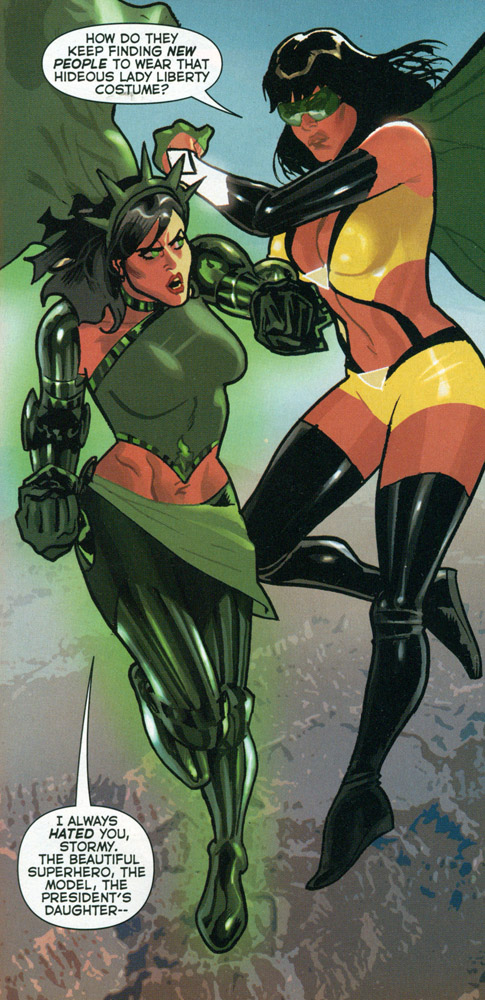
Not long after Dee Tyler’s death, her successor emerged as a member of Father Time’s covert ops organization, S.H.A.D.E. The third Phantom Lady was Stormy Knight, daughter of another Senator Henry Knight. Stormy’s public image as a party girl (her dual identity is publicly known) belies the fact that she holds a degree in quantum physics. Her moral compass was always true. In one mission, she did not hesitate to express her distaste for “collateral damage” on S.H.A.D.E. missions. (Crisis Aftermath: The Battle for Blüdhaven #2)
Stormy’s father was on track to become President, and Senator Knight clashed with Father Time over his plans against metahumans. (DCU: Brave New World) Still, when Knight ran for President, he criticized teams like the Justice League and advocated a government-sponsored team, which was all-too convenient for Father Time. Time introduced Knight to a shape-changing alien called Gonzo, who took Knight’s form, then killed him. (Uncle Sam and the Freedom Fighters vol. 1 #1) Gonzo, as Knight, was elected President. Elsewhere, the hero called Uncle Sam had sensed this treachery and convinced Phantom Lady and her teammates to join his Freedom Fighters instead. (#2)
Phantom Lady’s powers were generated by a pair of wristbands which could manipulate the fourth dimension. Stormy’s bands allowed her to shift partially into that dimension and become immaterial. It is unknown whether Stormy was related to Sandra Knight, or whether her equipment was based on Sandra’s black light ray. Among the Freedom Fighters, she unlocked even greater potential: near limitless teleportation. Stormy successfully teleported whole buildings into Uncle Sam’s other-dimensional Heartland. These became the Freedom Fighters’ base of operations. Naturally, Stormy was conflicted about battling her own father, but Uncle Sam soon confirmed that her father had been killed. (#4) After Gonzo was exposed, the new President put the Freedom Fighters in control of S.H.A.D.E. (#8)
For all her bravery, there were times when Stormy’s night life interfered with her “day job” as Phantom Lady. She’d previously admitted that she used substances to relieve the stress of her work. During one such binge, Stormy became a media sensation—and a liability to the Freedom Fighters. In a battle against the Futurist Militia, Phantom Lady killed the metahuman called the Thunderer. Her teammates responded by sequestering her to the Heartland. After visiting her mother, a patient at the Templeton Psychiatric Center, Stormy attempted suicide. (#2)
She was found by Doll Man, who saved her from death. Once she regained her faculties, Uncle Sam challenged Stormy to clean up. (#3) The team later learned that Stormy’s actions may have been due to manipulations by a rogue associate, the telepath Director Robbins. (#4)
Stormy did indeed clean up, and took some time off to act in a film called Kindness of Strangers, for which she garnered critical acclaim. (#8)
Since then, she and John Trujillo (the Black Condor) have given in to their mutual attraction. (Freedom Fighters vol. 2 #6)
New 52
When the DC universe was rebooted in 2010, the Freedom Fighters family of characters were completely reimagined. Phantom Lady IV was Jennifer Knight. She appeared in a few series but never in the mainstream DC universe of this era.
Rebirth
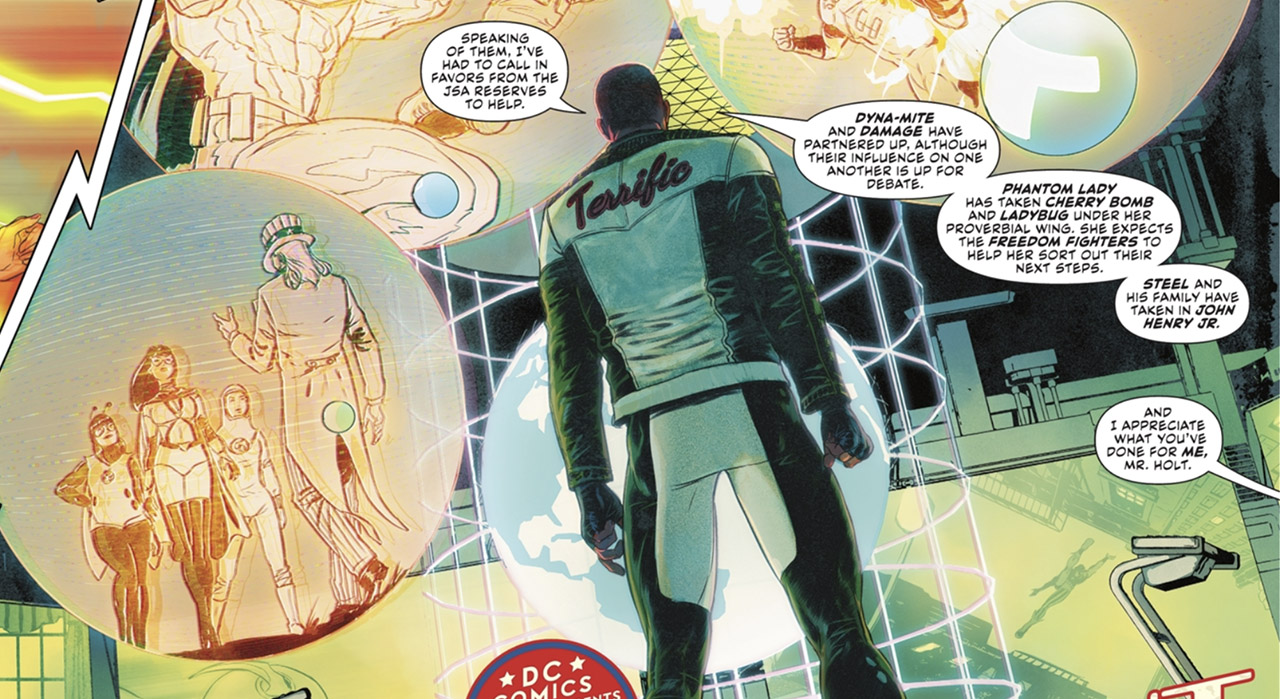
DC's "Rebirth" (2016) undid much of the New 52 and the previous version of the Freedom Fighters was restored. Stormy was asked to escort two young heroes, Ladybug and Cherry Bomb into the care of the Freedom Fighters. These girls had been kidnapped in the 1940s and hidden away, outside of time.
Notes
Stormy’s co-creator, Justin Gray, offered this online: “[Daniel Acuña’s] decision to exaggerate her breast size only stood to further her reputation and presented an interesting duality. …At first glance we see this anatomically impossible figure and that causes people to judge her in a certain light, but the more you get to know her you discover that not only are appearances deceiving but they can also be a negative when trying to be taken seriously. She’s a genius but few people can see past her chest. Yes, make jokes now to illustrate my point.” (“Uncle Sam…”)
Powers
Stormy Knight employs advanced technology. She holds degrees in quantum physics, and her wristbands can warp time and space itself. Like her predecessor’s, the bands can also create total darkness, but her most formidable ability is teleportation. There appears to be no limit to the size or distance she can manipulate with this technology..

Phantom Lady IV
NAME + ALIASES:
Jennifer Knight
KNOWN RELATIVES:
Harry Knight and unnamed mother (parents,
deceased)
GROUP AFFILIATIONS:
None
FIRST APPEARANCE:
Phantom Lady #1 (Oct. 2012)
APPEARANCES:
- Phantom Lady #1-4 (2012)
The New 52: Phantom Lady IV
Created by Justin Gray, Jimmy Palmiotti, and Amanda Conner


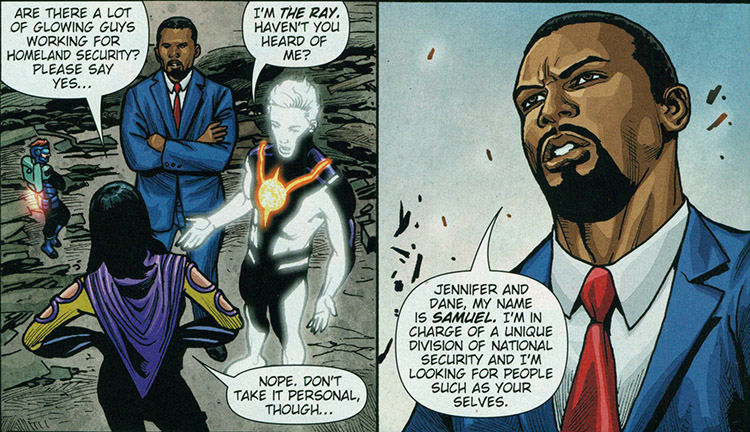
In this reality, Phantom Lady was Jennifer Knight. Her story was interwoven with that of Dane Maxwell, Doll Man. The two knew each other since childhood and they share a romantic connection.
Jennifer's story was also tied to that of her father, Harry Knight, a renowned writer for the Daily Planet. When Jen was six, Knight's stories about Robert Bender, head of the Bender crime family, earned him and his wife a ticket to early graves. Motivated by grief, she took up her father's profession as a journalist. Her byline appeared mostly on stories about Metropolis nightlife, but she wrote anonymously about her parents' killer, Cyrus Bender. When her identity was uncovered, she reached out to Dane Maxwell for help. Maxwell was a tech genius who'd created a way to make himself six inches tall! (Phantom Lady #1)
Bender kidnapped and tortured Jennifer until Dane came to her rescue. He wore a mask and armor outfitted with a jet pack and lasers. When they returned to his lab, he outfitted Jen with weapons of her own. One allowed her to become intangible and a pair of gauntlets allowed her to shape a kind of shadowy matter into any form. The two trained together in Calvin City and coined codenames: Phantom Lady and Doll Man. Their first super-adversary was Funerella, hired by Bender. (#2–3) Notes: Calvin City was the home of the Golden Age Atom. Funerella was a carry-over from Freedom Fighters #4 (Feb. 2011); she looked the same here.
Ultimately, not even a suit of super-armor could save Bender from the horrors of Phantom Lady's shadow realm.
After his defeat, the duo were approached by Uncle Sam, representing Homeland Security. "Samuel" recruited them for a new team to "defend the freedom of our nation and promote democracy and peace." They met the new Ray and Human Bomb. (Human Bomb #4) but no other adventures followed these heroes in the New 52 or afterwards.
Powers
Dane Maxwell invented Phantom Lady's formidable blacklight gloves. The gloves are controlled by a neural interace woven into the hood of her uniform. They give her the ability to manipulate a form of shadow-matter called "hard light," and to move within shadows (an ability which mirrors much of what her immediate predecessor could do). She can create, mold, and bend shadows to her will using her gauntlets. They can become solid, malleable, and also allow her to "shadow slide" between locations via the darkness. The shadowy void is one of total sadness, like death, and claustrophobic. A second device allows her to make herself immaterial. Her uniform requires recharging every two hours.