

Plastic Man
Created by Jack Cole

NAME + ALIASES:
Patrick "Eel" O'Brian
KNOWN RELATIVES:
Lucas “Luke” Ernie McDunnagh (Offspring, son), Angel McDunnagh
(ex-wife), Edwina (ward)
GROUP AFFILIATIONS:
FBI, All-Star Squadron, Freedom Fighters, Justice League of America
FIRST APPEARANCE:
Police Comics #1 (Aug. 1941)

Woozy Winks
NAME + ALIASES:
"Woozy" Winks
KNOWN RELATIVES: Wanda (wife), Weezer (son), Blinky Winks (uncle)
FIRST APPEARANCE: Police Comics #14 (Dec. 1942)
Plastic Man was the unique creation of Jack Cole, a cartoonist whose work on the character has elevated him to the status of “comic book royalty,” but whose career was cut short by suicide. The seeds for this character (Quality’s second most popular, after Blackhawk) can be seen in Cole’s earliest work. In 1935, Jack drew autobiographical cartoons for an article in Boy’s Life about his cross-country bike trip from Pennsylvania to California. In these single-panel cartoons, his style was already fully developed. They show Jack making fun of himself: a wiry, bendy figure with a goofy face, and the panel borders are twisted and off-kilter. Naturally, Cole had been a fan of newspaper comic strips. His figures were more in league with E.C. Segar’s Popeye than Hal Foster’s Flash Gordon, but fate threw Jack Cole into the burgeoning world of the comic book hero, where he invented intriguing ways to infuse cartoons with adventure.

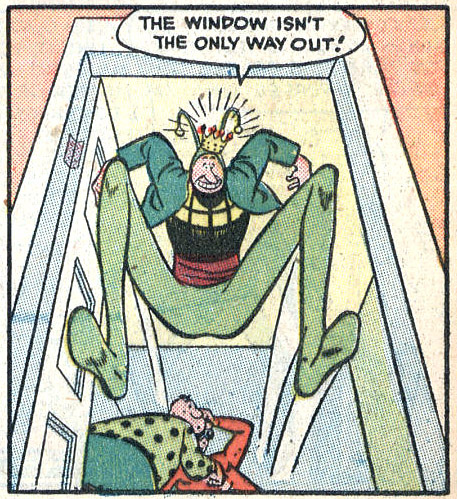
Jack Cole’s experiences on that bike trip informed his stories, and the colorful characters within them. Plastic Man’s adventures spanned many American locales, and revealed Cole’s keen sense for pop culture. Jack infused his stories with elements of entertainment and science, including early references to television and rocketry.
Prior to creating Plastic Man, Cole warmed up with Midnight, a character that Busy Arnold intended to be a copy of Will Eisner’s “The Spirit.” Whatever Arnold’s intentions, Cole’s Midnight was nothing like Eisner’s Spirit. Midnight debuted in Smash Comics #18 (Jan. 1941), only about a half-year ahead of “Plas.” That boisterous feature displayed some of the elements that Cole wold bring to his own original creation.
Plastic Man debuted in Police Comics #1, in the summer of 1941, as a six-page back-up feature. The cover star of that issue was Reed Crandall’s “Firebrand,” but that wouldn’t stand for long. The first installment was an origin story. Our hero—who began as a common criminal named “Eel” O’Brian—was orphaned when he was young, leaving him to fend for himself on rough streets. (Later stories explained that he earned his nickname by being so adept at eluding the authorities.) O’Brian was left behind by his gang at the Crawford Chemical Works, and after being shot and doused by acid, he limped to safety on a remote mountain. When he awoke, he found he’d been taken in by a monk at a place called Rest-Haven. The acid had imbued him with the incredible ability to stretch and mold his body into any shape! He saw the opportunity to turn over a new leaf and vowed to use these awesome powers to fight crime. When he left the Haven, his first mission was to take revenge against his former gang. He donned a red rubber suit and returned to infiltrate them. They were stunned by the freakish powers of Plastic Man and fled to their getaway car—which was driven by O’Brian. He promptly dropped them off (literally) at the nearest police station. (Police #1)
Plastic Man’s costume included black boots in his first two appearances, but afterwards he was always bare-legged. His costume was also split down the middle, colored red on the left, black on the right—just like the Daredevil, a hero whom Jack Cole drew for Lev Gleason beginning with Silver Streak Comics #7 (Jan. 1941). The stories were similarly boundless, but with Plastic Man, Cole brought a new level of finish to his storytelling. Cole abandoned “Daredevil” to create Plastic Man, but he also continued to do “Midnight” for well over a year. By issue #5, Plastic Man’s bi-colored costume was red only. And when O’Brian took the form of Plastic Man, he made a conscious effort to differentiate his features.
In his second case, he approached the police and offered to solve a case for them. In exchange they would have to let him on the force. Captain Murphey of the Mammoth City police (first spelled “Murphy”; city named in #18) agreed, but only if Plastic Man would also round up Eel O’Brian! He infiltrated a gang that was smuggling drugs inside corpses from Canada. Plas followed the trail to its boss, a senator, and just as the police arrived, Eel O’Brian escaped. Afterwards, Plas argued that the police let Eel escape, and Murphey allowed Plas onto the force. (#2) Captain Murphey had an uneasy alliance with the new hero. He mandated that Plas must solve one major case per month, or lose his badge. (#3)
Madam Brawn’s Crime School for Delinquent Girls led a campaign to take over the protection racket in Windy City. While Eel O’Brian wiggled his way into the racket, Plastic Man tried to reason with Brawn. He was rewarded by being tied into knots. After escaping, he granted her leniency, but she vowed revenge. (#4) The cigar-chomping Brawn returned unrepentant. In the battle, Gassin Gert used her gas gun and Brawn fell on a spike and died. Before her end, Plas actually revealed his secret identity to her. (#5)
The man with the Stealing Hands was cursed by an Indian prince and his hands became capable of detaching themselves from their owner’s body. He couldn’t stop them from stealing, and eventually cut them off. Plas threw the hands into a furnace to set the man free. (#6)
Plas wasn’t above stealing some furs in order to infiltrate and join the United Crooks of America. One wiseguy opposed Eel’s joining when he noticed that all of O’Brian’s other gang buddies wound up in jail. He was right; before the night was over, the UCA were rounded up. (#7)
Jack Cole’s uninhibited style led to great freaks like Prof. McSneer, who invented the Eight Ball, a rolling destructive machine that attracted precious metals. (#8) Hairy Arms was a gang leader who served Axis powers. When his gang learned about that, they defied him and sought help from Eel O’Brian. Plastic Man followed up with fellow cop, Officer Plotz. Hairy Arms kidnapped a boy and left a ransom note instructing authorities to leave $50,000 at Wildwood Cemetery, where he was found manufacturing an army of robots. His own men helped take him down. (#9) Note: Wildwood Cemetery was the home of the Spirit! There is also a real world cemetery by that name in Massachusetts, a state to which Cole later moved.
His first super-powered villain was Cyrus Smythe, who was killed by a monster of his own creation in 1642. The monster left him in a chemical bath that allowed Smythe’s body to die but made his brain immortal. He was buried for centuries until soldier Tad Wilkins died near Smythe’s opened grave. The medics mistakenly inserted Smythe’s brain into Wilkins, and Cyrus assumed the soldier’s life back in America. Like Smythe’s monster, he could now grow to great heights, and soon came into conflict with Plastic Man. The battle resulted in the body’s death, but Smythe’s brain was buried alive again. (#11) Note: DC’s villain, the Ultra-Humanite, also had a mobile brain. He first appeared in Action Comics #20 (1940). A similar freak, Giganta, came in Wonder Woman #9 (1944). She had elements of both size-changing and brain transference.
The Swami had super-powers that were hindered by Plastic Man’s very existence. (#12)
Getting Woozy
When Woozy Winks casually saved the life of Zambi the Soothsayer, little did he realize that he’d be rewarded with invulnerability and immunity to pain. Winks described this as “protection from Mother Nature.” To decide his path, Woozy flipped a coin and pursued a life of crime, soon becoming partners with Eel O’Brian. Plas eventually convinced Woozy to turn himself in, but the police discovered that because of his powers, Woozy couldn’t be held, and could simply saunter out of custody. Rather than serve his sentence, Winks was offered redemption—he could help Plas catch Eel O’Brian. (#13) Plastic Man convinced Murphey to release Woozy into his custody. (#14) Boreas, the north wind, was “controlled” by a machine in the possession of Don Snitzel. The wind was useless on Woozy, who shrugged off all attacks; any punches were also met with equal and opposite spontaneous force. (#15)
Woozy became a regular co-star. He appeared in most of Plastic Man’s adventures after his introduction. And without fail, if Plastic Man told Winks to bug off, he would inevitably ignore the request and muck up the case. Winks claimed that he had no living relatives, (#14) but he and Plas once met his uncle, Blinky Winks, on a case in the countryside town of Hay Hollow. (#30)
Their next case took them undercover on the Blackfoot Indian reservation to squash an uprising led by Chief Great Warrior. The Chief had the mystical ability to project himself through reflective surfaces. (#16)
Later Woozy got his own feature beginning in Plastic Man #3 (March 1946). This feature bore more of Cole’s signature style, at a time when other artists had begun drawing “Plastic Man,” too. Woozy was always short on money, so he decided to emulate his pal and bring in crooks for the reward. He freed a prisoner thinking he’d turn the man in, but instead Winks wound up in the slammer, too. (Plastic Man #3) Woozy usually found himself done in by the crooks he was trying to catch, and he solved cases rather by accident. By this time, the pretense of his “invulnerability” was forgotten. Woozy occasionally struggled to stay on the straight-and-narrow himself, and was a bit of a kleptomaniac. Also, it was suggested that “Woozy” inferred “tired,” not “drunk.” He was never really a boozer, but he was definitely lazy.
G-Plastic-Man
Cole’s second major change to the world of Plastic Man was enlisting the hero with the FBI. Plas had been deferred from civil service during the war because Captain Murphey needed him more on the home front. It was the President himself who requisitioned Plastic Man’s services for the FBI. The post was confirmed by a telephone call; Plas would work for the government on counter-espionage. (#18) Plas was a natural undercover agent because he could shape his features in any way. His first case as a “G-man” took him to the north woods Hadley Lumber Company. It was for sale, but lumbermen were turning up dead left and right. Further investigation revealed a boneyard in the forest which was protected by killer trees! The trees’ inventor was a mad scientist who’d successfully engineered animals to be plants, and vice versa. As the forest was consumed by flames, Plas thought he was finished and revealed his identity to the scientists’ henchmen. After they were saved, Plas let the crooks go in exchange for keeping his secret. (#19)
Cole wrote himself into the story for Police #20 as a stuttering dweeb. It was a “dream” tale in which the heroes were knocked unconscious in an explosion. Then Woozy called upon Jack Cole to draw the faces of crooks Abba and Dabba for a “wanted” poster. In the dream, Cole’s unnamed (and obscured) publisher freed him from the crooks. (#20)
At the FBI, Plastic Man answered to Chief Branner, who was strict in his ideas about jurisdiction. He denied P.M.’s request to help the darling mute boy called Bright Eyes. One look into at Bright Eyes and the beholder was powerless to do wrong. The boy was the prisoner of his own disfigured father, the Sphinx, who used the boy’s persuasive eyes to get away with murder. Only the Sphinx’s death allowed the boy to speak again, and tell of the abuse he’d suffered at his father’s hands. (#22)
Pinky Flowers teamed with Dr. Phineas T. Gleason to create their own Plastic Men out of reclaimed rubber, and controlled them with robotics. Woozy found their laboratory and was himself transformed into a Plastic Man. His survival ability enabled him to live through the process and he helped solve the case. (#24) Number Seven was a disfigured World War I vet who wielded a gun that shot liquid fire. (#25)
To his credit, Chief Banner ultimately discovered that Plastic Man was in fact a “most wanted” criminal. The jig was up! Plas was ready to submit and do his time, but Chief Branner found him too valuable. The Chief gave him one day to prove himself by bringing in not one, but three slippery felons. Each was a unique challenge, one of brawn, one brains, and one of soul (a werewolf, no less). Branner was impressed and absolved O’Brian of his past. (#26) After this, Eel O’Brian all but disappeared as a player in Plastic Man’s cases. In his post at the FBI, Plastic Man’s cases were split between domestic affairs and those relating to the war. He even went to Hollywood to consult on a film being made about him. (#28)
The solo Plastic Man title was first published in 1943, but due to publishing restrictions, only two issues were produced during the war. In addition, Jack Cole was spread thin by the absence of Quality’s art staff, who were off serving in the military. After the war, Cole could devote more time to his creation, and Plastic Man was restarted, featuring four new tales in every issue. By issue #10, it was obvious that other artists were also being employed to fill the book. Most of Cole’s early work was signed, but by 1946 it was Quality’s preference to omit bylines from its comic features. Stories in Plastic Man are all unsigned, and some are clearly lacking in Cole’s signature style. Those that were drawn by Cole probably employed a separate inker, which made the finished product look a little less “wacky” than those early Police Comics appearances.
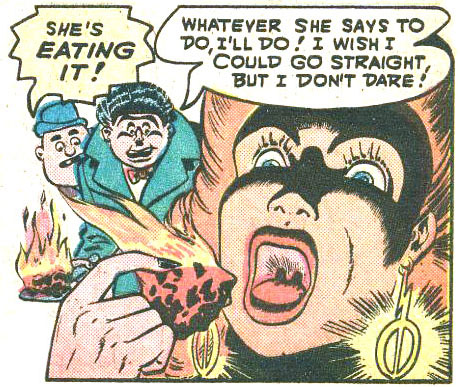
Stories were also now probably written by separate writers, and they followed familiar formulas. Many dealt with Plas’ detective work, and some introduced super-powered villains to challenge him. Fargo Freddie was transformed after plunging into a volcano. Inside he met a 500-year-old man who showed him how to become lava. As Lava Man, he slipped out of Plastic Man’s grip, but was defeated when his body was cooled and hardened. (Plastic Man #2) (He also fought a Lava King in issue #43.) Professor Chase injected a thief with a serum that turned him into the Grasshopper, with the ability to leap long distances. (#6) Police scientist Dr. Ray invented a gun that could imbue living creatures with the ability to generate great heat. When Ray came face-to-face with the gangster called Hot Rod, the gun caused Hot Rod to burst into flames because of the presence of gunpowder. (#7) Electra ate red hot coals and produced electricity from her fingertips. (#10) The river was home to the horrible freak called Riverman, who sported fins, claws and webbed feet. He was the last of his kind—humans born with gills and banished to the deep. (#12)
Back in Police Comics, it was business as usual. By comparison, the stories in this title involved fewer super-powered menaces and more murders, midgets and mad scientists.
He and Woozy traveled to the British Island of Bladau when they believed Winks was the beneficiary of his dead uncle, Jeffrey Winks. Woozy stood to inherit the title of “Earl” and a million dollars a year! In the end, he found that the true inheritor was Moozy Winks, and Woozy was no relation at all. (Police #39)
One complicated tale followed the rich man, Van Rooten, and his attempt to return New York City to the Indians who’d originally sold it to his family. The Indians turned out to be frauds and Van Rooten realized his error. (#45)
Doctors Doser and Slicer sought to unravel the secret to Plastic Man’s powers, but found that Plas couldn’t be pierced or cut in any way. (#47)
Woozy’s friend Jasper Tipple invented the city of tomorrow. Sadly, the only backer he could find to build it was the mobster, Big Beaver. They built Futuria and Plastic Man had to root the crime out of it. Afterwards Tipple vowed to use the city as a teaching tool. (#48)
Other foes included the super-hypnotist Thelma Twittle (#49); Miss Sheila Sorrell was turned to super-strong stone and driven mad by Professor Carlon (#51); Dr. Erudite invented a Protoplasm machine and created a duplicate of himself (#53); Sleepy Eyes could hypnotize people to sleep, but Woozy was immune because of his natural sleepiness. (#55)
The guys met a bona fide Martian called Mr. Misfit, who alerted Plastic Man to Professor MacGhoul’s plan to launch a rocket to Mars. Misfit wanted to protect the planet’s riches from MacGhoul. After Plastic Man prevented the launch, Mr. Misfit disappeared, leaving his disguise behind; they never got to see the Martain underneath. (#57)
The Green Terror worked for years with strange plants and began to take on their characteristics. He took revenge on Woozy for destroying one of his experiments, and subjected him to a great “smother plant” that exhaled large quantities of carbon dioxide to suffocate its victims. This villain bled green blood when he was stabbed by his own weapon. (#58)
More eccentrics followed… Miss Van Doom was beautiful but deadly (#62); the Crab had wide mouth and sharp teeth and kept a hideout below an amusement park (#63); candy makers Cherry and Gumdrop were also counterfeiters (#64); the Gag Man robbed banks after calling loads of kids to Plastic Man’s FBI office to cause chaos (#67); and the Brain Trust attacked Plas and Woozy in Hollywood, where they’d been invited to be technical advisers on an FBI movie. (#68)
Plastic Man had only a few foes whose abilities mirrored his own. One was Stretcho, the circus’ India rubber Man who was nearly as adept as Plas in contorting his body but had limits and could feel pain when he pushed it too far. Stretcho feared that Plas would steal his thunder (and income) at the circus. (#69) Mr. Scroggs invented a dream control machine. (#78) And the freakish Eaglebeak swooped down from above, riding a huge eagle, Rollo. (#79)
Mad professors abounded: Prof Spindrift created a mechanical headless man to be worn like a suit of armor. (#60) Prof. Abelson talked Woozy into helping him break into a museum where he brought a Greek statue of Eloc (“Cole,” backwards) to life. Eloc caused much mayhem but reverted to stone and was crushed to bits in the end. (#77) The brilliant and disgruntled Prof. Growley applied his talents to crime, discovering an equation that would disperse his own atoms so he could pass through solids. As Penetro, he helped steal rare treasures. Plas disguised himself as a woman and tricked Penetro into turning solid so he/she could “embrace” him. (#80) Gargantua the Phi Beta gorilla was transformed by Prof. Brewster. His cosmic ray turned Gargantua into an intelligent talking creature that attempted to put his brain inside Woozy’s body! Plas got Brewster to revert the ape. (#81)
By Police #83 (Oct. 1948) the art on “Plastic Man” bore less and less of Cole’s signature facial quirks. The features are unsigned, so we can’t say for sure, but it’s very likely that Cole either ceased drawing it, ceased caring, or his inkers altered the feel significantly. The last dozen-or-so issues of that series featured fairly unmemorable tales, save perhaps for the Black Widow, who divined secrets from a crystal ball. She killed herself when her poisonous bullets bounced off Plas and back at her. (#96) And the landmark Police #100 wasn’t celebrated in the way comic publishers do today, but it did feature a pretty classic Cole creation, Thrilla, another woman with electricity jumping from her fingers—and lips. When she tried to kiss Plastic Man, whose form was insulated against her, the feedback knocked her out. (#100)
Over in Plastic Man, there were lots of far out characters coming to town. The odd-looking Cargill became Concrete. (Plastic Man #14) The astounding Uno came from 4 million A.D. seeking people to help him repopulate Earth. The first people he encountered were the Rattler and his moll, Tina, who were whisked away to the future in Uno’s spherical ship. On a return trip, the Rattler used Uno’s disintegrating ray on Plastic Man. Luckily, it had a reverse setting. Tina and another woman ultimately decided to stay with Uno in the future. (#17) Sadly-Sadly Sanders had a face so pitiful that looking upon him induced uncontrollable sobbing. He used this to commit robberies and Plas solved this by getting Sadly to laugh. (#20) Amorpho was a blob-like creature who arrived from outer space. He was capable of mimicking Plastic Man’s power, but was no match for his prowess, so he agreed to get back in his ship and return home. (#22)
Post-Police Comics
Cole produced “Plastic Man” fairly consistently through its run in Police Comics, which ended in #102 (Oct. 1950). After that, the title changed to all adventure features, but Plastic Man continued bi-monthly for another six years. In Plastic Man #43 (Nov. 1953), Quality began inserting reprint stories (it was also done in issue #34). After that, reprints were common and by #53 (April 1955), reprints filled the entire book. The title continued to issue #64 (Nov. 1956), when Quality ceased publishing.
In his latter-day tales, Plastic Man still worked at the FBI for Chief Banner. (Plastic Man #26) He fought a fair number of garden variety mystics and magicians like Bazooka Khan, (#20) Kra Vashnu, (#21) Hypno, (#27) Hypo, (#35) and Dick Tracy-style thugs such as Spadehead, (#12) Bubblehead, (#32) and the high-domed Mastermind. (#49)
At the chemical plant, a hapless window washer’s bucket water was transformed into an agent that dissolved glass. Willie Glasswipe took advantage of it to commit theft and found he could also pass through walls. At sea, Woozy was swallowed up by the giant Monster of Llendwymorra, which was actually the vessel of the pirate, Dutyfree. (#28) Mr. Fission was created by a trip into a cyclotron, from which he emerged with the power to cast radioactive rays. (#32) On a north woods vacation, an animal trainer and wannabe lumberjack dressed his men up as the Wolf Men. (#34) The Porcupine shot quills from the back of his jacket. (#35) And Plastic Man’s strangest quarry might have been the scientifically advanced elves of Inner Earth. (#37)
The tales in Plastic Man #38-43 (Nov. 1952-Nov. 1953) took a strange turn to the dark side. These stories were laced with horror and dark shadows and were no doubt influenced by contemporary trends in the comics industry (not to mention Cole’s involvement with True Crime Comics for Magazine Village and Web of Evil for Quality). Plastic Man #38 first featured a grim and humorless tale which followed Plas and Woozy into the Korean War (which had begun two years earlier). Men were succumbing to a strange germ warfare and Plas helped fend off Communist attacks. Woozy agreed to be a decoy in order to discover the North’s chemical lab. This enabled Plas to steal a sample that could be used to develop an antidote and vaccine. The second tale in that issue was also dark—literally—as Plastic Man was depicted covered in shadows. When the corpse of Monk Mauly and others crawled out of their graves, Plas pretended to be Satan and frightened them all back into the ground. In the third, the creepy Karlo Karzon unleashed his voodoo powers, which he applied to enchanted wigs to kill his rival actors. (#38) The following issue was strewn with similar themes and dark shadows, voodoo, skeletons, hellfire and ghosts. Even Woozy’s adventure was creepy. “The Beast with Bloody Claws” introduced a great mechanical dragon controlled by the Communist Chinese. (#41) Zelda, the “Witch of the Wailing Woods” was a dark seductress. Plastic Man reversed her voodoo powers by making himself look like her. Then when her henchman twisted his head, it was she who died from the trauma. (#42)The creepy Count Dronga was actually a good guy, framed by Sam Gahoul. (#43) Someone soon realized that horror and Plastic Man made a poor pair, and the tone of the book returned to form with issue #44.
The remainder of Plastic Man’s original Quality Comics adventures were very much in the straight super-hero vein. Marloff Ogre used his Stamina Machine to transform a man into the strong, fast Ogre. Orange scientists from Saturn could become invisible and tried to kidnap Woozy until Plas put their rocket on a return trip home. (#45) The hairy black Spider was an inventor, Mr. Stacy, who used a wire-shooting gun. (#46) A pair of Russian spies worked for the Soviet Union’s NKVD. Their agent, Iron Fist, wore a metal glove and commanded the sumo, Agent DX and the Egyptian Saber. (#50) Madam Morpheus used a hypnotizing eye beam. (#51) Plas’ last case was against the multi-talented Wizard. (#52)
Notes
In Police #6, Plas addressed the reader, thanking them for sending letters about the feature. He asked if readers would like to see the feature go from six to nine pages. That it did, relatively soon; with issue #9, Plastic Man jumped to the lead spot, but he’d already taken over the cover with #5.
Woozy mentioned the Human Bomb in Police #17.
Notes
In Police #6, Plas addressed the reader, thanking them for sending letters about the feature. He asked if readers would like to see the feature go from six to nine pages. That it did, relatively soon; with issue #9, Plastic Man jumped to the lead spot, but he’d already taken over the cover with #5.
Woozy mentioned the Human Bomb in Police #17.
Pit Stop: M.F. Enterprises
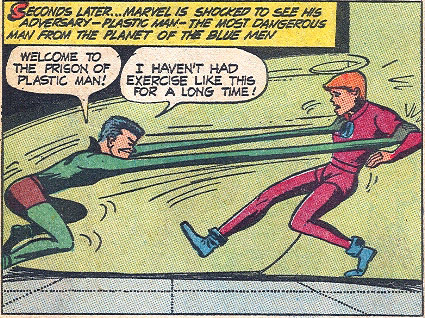
In early 1966, just before DC revived Plastic Man, another ambitious publisher attempted to cash in on some Golden Age properties. M.F. Enterprises was probably the first to gamble that these characters might no longer be protected by copyrights. If only their comics had been good, we might today have a very different comics landscape. M.F. Enterprises launched their own Captain Marvel title, which lasted for less than a year. Marvel Comics wouldn’t create their own Captain Marvel until a year later.
The first issue (April 1966), introduced a Captain Marvel that was goofy as all-get-out. By yelling “split!” his limbs and head would disattach. Conversely, “xam!” would reassemble him. His arch foe was Plastic Man… yes, “the most dangerous man from the planet of the blue men.” The blue men were aliens who had come to Earth. Plastic Man escaped and returned the next issue.
A month later, Plastic Man was “Elasticman” and he had a friend in tow: Tinyman (after Doll Man?). If you can imagine, things got even crazier with the third and fourth issues. Another villain called “the Bat” was introduced and sure enough, the next issue his name was also changed, to “the Ray.”
Elasticman returned once more in Captain Marvel presents the Terrible Five #1 (1966).
Plastic Man II
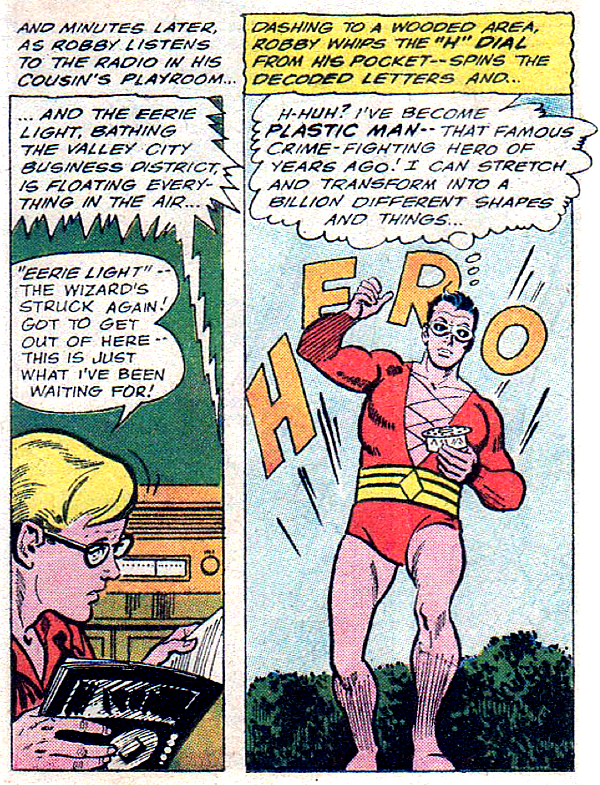
In 1966, DC Comics was experiencing a renaissance fueled by the popularity of the new Batman television show. By this time, DC’s own stretching hero, the Elongated Man—also sporting a red outfit with a yellow belt and a deep v-neck—had been appearing in The Flash for over five years (The Flash #112, May 1960). Plastic Man fit the bill for a campy revival that began with a preview of sorts in House of Mystery #160 (July 1966). This issue by Dave Wood and Jim Mooney starred Robby Reed in the “Dial H for Hero” feature. As the cover proclaimed, this issue featured “a new old hero.” Reed’s wristwatch, when dialed, would transform him into a different super-powered hero every time. Carrying the concept further, Reed would also use the Dial to transform into an “old new hero” and a “new old hero.” Saving Plastic Man for last, the writer conjured “that famous crime-fighting hero of years ago”—Plastic Man. Reed used the power of plastic mostly to form elongated limbs and to shape himself into a ball. It was a far cry from Jack Cole, but power enough for Robby to outwit his foe, the wizard Drago.
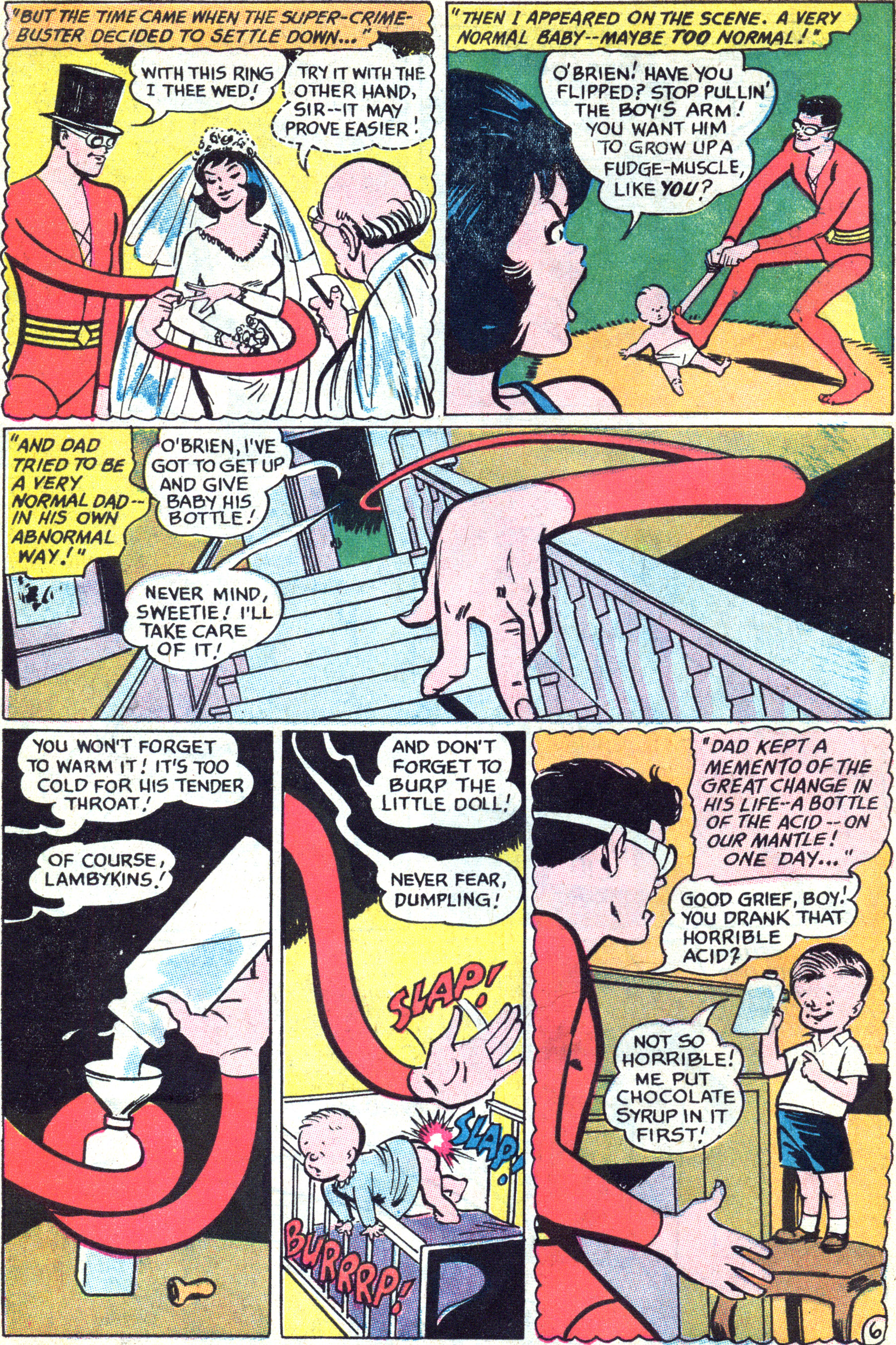
Later that same year, DC officially relaunched the hero in his own title, heralding “an epic event” on the cover. The series was penned by Arnold Drake (creator of the Doom Patrol) and drawn by Gil Kane. The new Plas wore red tights instead of his famous bare legs. In issue #7 (1967) we learned that this Plastic Man was the son of the original. Plastic Man had married (an unnamed woman) and “baby Plas” was born without special abilities. One day early in his life, “Junior” got into his pop’s stash of the acid that originally transformed him into Plastic Man (he’d kept it as a memento). The boy was likewise transformed and grew up to take on his father’s mantle as Plastic Man II.
In his first adventure, the new Plastic Man was generally recognized in public. The supporting cast was all-new, too. Woozy was replaced with the young Gordon K. “Gordy” Trueblood, who owned a pet store. Plastic Man’s girlfriend was heiress Micheline “Mike” deLute III. Space-age and mod forms were on the rise and evident in his new arch-foe, Dr. Dome and his daughter, the whip-wielding Lynx. Curiously, Dr. Dome’s lackey was named Professor X. (Plas was also opposed by Mike’s mother.) (Plastic Man vol. 2 #1)
The new Plastic Man could change his color as well as shape. Dr. Dome was a recurring villain who sported an oversized silver helmet that covered his eyes, and he wore gauchos. Dome claimed that he’d been doing battle with Plas for seven years already. In order to destroy him once and for all, the villain devised a plan to unearth Plastic Man’s origin. Lynx would interview three people close to him (police Capt. McSniffe, Mike’s mother, and Gordy). Each told them a different “origin.” McSniffe told Lynx that he once met a man called “the Eel” who came from Migraine, Missouri to infiltrate a gang and bring it down from within. Together they crafted a sting on the gang leader called the Spider. During their scuffle, the Eel fell into a vat of “nutty putty” and emerged as Plastic Man! Mrs. De Lute said that Plastic Man was an undercover detective who saved her from the Japanese Beetle and was transformed by a tank of acid. Gordy believed that Plas gained his powers from a tainted batch of yogurt. When Gordy asked Plas about these discrepancies, he replied that his origin was his own secret. (#2)
This Plastic Man may not have always been intended to be the son of the original. But due to readers’ demand to see Woozy Winks, the creators were left with a dilemma. In Plastic Man #7 Plas and Gordy teamed up the elder Plastic Man and Woozy, who were now running an old folks’ home called Plastic Acres. The residents there were exceptionally lively due to a special “spa” which gave them extra vigor. Soon a crook called the King of Spades (and his Queen of Hearts and Jack of Diamonds) were plotting to get at this fountain of youth. They let him have it; it was infused with booze and it wasn’t long before the King and his gang were out cold.
The revival lasted only ten issues. No doubt fans of Jack Cole’s Plastic Man were left wanting by Drake’s interpretation. Marc Svensson interviewed Drake and said via e-mail that the writer, while proud of his work, never felt that he got a complete handle on Cole’s character. Perhaps the only legacy from this series was the addition of Plastic Man’s blond bimbo love interest, which appears in most successive incarnations of the character (even in the 1979 cartoon).
Plastic Man made a brief cameo in 1967’s Inferior Five #2. That appearance essentially placed him on DC’s “Earth-12” in the pre-Crisis multiverse (this Earth was designated during the Inferior Five’s appearance in the Oz/Wonderland War). Plas helped the Five take down a group of villains who parodied the Fantastic Four. Of course, he was key in defeating the stretchable Mr. Manplastic.
Back Again
When Plastic Man was relit in 1976 (with the same numbering sequence), it was “business as usual” with Plas—and Woozy Winks. His origin was retold in issue #17; it was identical to that of Police #1. Editors had taken note of the fans’ requests and returned the character to classic form. It lasted for another ten issues. Steve Skeates’ revival series reads much more cleanly than its forebear because it’s not bogged down by DC’s mid-’60s obsession with “groovy go-go” this and that. Ramona Fradon’s art was much truer to Jack Cole’s, and Plastic’s uniform was back to its original look, too. Plas was again working for the government, but at DC it was called the NBI (National Bureau of Investigation).
Issue #11 unveiled his new supporting cast: the NBI’s ditsy office girl Sundae Supplement and rival agent Gully Foyle. This Plastic Man was definitely part of the mainstream DC universe. He made a guest appearance with lots of other heroes in Justice League of America #144 (July 1977).
The creators had some fun by returning Robby Reed and his H-Dial. This time Robby was under the influence of a villain and when he dialed up Plastic Man again, the two duked it out. (#13) Agent Foyle was eventually revealed to have been the victim of a ray gun that turned him into the evil Kolonel Kool. (#16)
They’d finally gotten it right, it seemed. Fradon’s art started out so wonderfully… “plasticky”… but by the end had become very “super-hero-ey.” The following year, this and many of DC’s books were canceled in the so-called “DC Implosion” of 1978.
Modern Plastics
In the period up until the Crisis on Infinite Earths, Plastic Man appeared only as a member of the World War II era All-Star Squadron. In this series, Roy Thomas grouped heroes from all DC properties together under a common umbrella. Thomas was faithful to the Quality lore and made Plas a sort of liaison between the government and the hero community.
The Crisis collapsed DC’s infinite Earths into one (ostensibly) easy-to-follow Earth and timeline and 1989’s Plastic Man mini-series was a bona fide “reboot.” It introduced a modern-day Eel O’Brian. Filled with action by Phil Foglio and Hilary Barta, this story was perhaps the best of DC’s to date. It followed Eel through the acid bath and out onto the streets where he struggled to get a grip on his new powers. Even his old gang was frightened of him, but not Woozy Winks. Winks was newly paroled from Arkham Asylum and encouraged Eel to use his abilities for financial gain—whether for good or evil, they’d see which paid better. They began by applying the rubber-acid to an old circus outfit to create a costume for Eel. Together they successfully brought down Eel’s old gang, but the police offered no reward. The press mobbed Eel and asked his name, to which he hastily replied “Elastic Man?” The reporter heard something different and declared the new hero: Plastic Man.
Because of that mini-series, for a time it was unclear whether DC intended Plastic Man to be a Golden Age character or not. The timeline set forth in Zero Hour #0 (1994) also placed his debut in the Silver Age, but some writers ignored that. Plas later mentioned having worked with the Golden Age heroes Wildcat. (JLA #28) and the Red Bee. (#38) Other JLA stories by Mark Waid and Joe Kelly certain details called that timeline into question.
For the most part, his Quality adventures seem now to be “canon,” and Plastic Man’s DC history begins with his involvement in the All-Star Squadron. After Pearl Harbor, Plastic Man worked closely with the White House (via the FBI) and revealed his true identity to members of the Justice Society when they and other heroes converged in Washington D.C. (All-Star Squadron #1-2)
He has never been shown as a member of the Freedom Fighters but landed a major role in Grant Morrison’s mega-successful revival of the Justice League, JLA. Batman recruited him to help the JLA against a new Injustice Gang (JLA #11) and was soon inducted as an official member. (JLA Secret Files #2) He served with the JLA for quite some time.
Powers
Plastic Man can change his body into any shape that he can imagine. His physical make-up was changed in such a way that his entire body was composed of the same malleable substance. His body could survive almost any attack of force, including projectiles or heavy pressures. As a balloon, he could create the effect of super-breath. In the beginning, he could change his color, as well. In tales at DC Comics, he has struggled with that aspect. Being made of a rubber-like substance, he was insulated from electromagnetic energies.
His weaknesses involve extreme temperatures and glue. In recent appearances, acetone was used to “dissolve” him.
Plas’ friend Woozy Winks also had metahuman abilities. Upon saving “Zambi ze Soothzayer” from drowning, he was granted protection of nature, meaning nothing could harm him. (Police #13) He tested this by hitting himself on the head with a hammer and jumping off a cliff without being hurt. Woozy’s power provided him with a sort of shield from harm. Not only could he feel no pain when struck, but other disasters (like lightning, earthquakes, etc.) simply “slipped” off of him.
Note
The Plastic Man Archives:
- Volume 1. Police Comics #1-20 (1999)
- Volume 2. Police Comics #21-30 (2000)
- Volume 3. Police Comics #31-39 (2001)
- Volume 4. Police Comics #40-49 + Plastic Man #3 (2002)
- Volume 5. Police Comics # #50-58 + Plastic Man #4 (2003)
- Volume 6. Police Comics #59-65 + Plastic Man #5-6 (2004)
- Volume 7. Police Comics #66-71 + Plastic Man #7-8 (2006)
- Volume 8. Police Comics #72-77 + Plastic Man #9-10 (2006)
Appearances + References
» FEATURED APPEARANCES:
- Action Comics #661, 762, 791
- The Brave and the Bold #76, 95, 123, 148
- Green Arrow/Black Canary #8-12
- Green Lantern vol. 3 #103, 115–116, 134-136
- Green Lantern/Plastic Man: Weapons of Mass Deception #1
- House of Mystery #160
- JLA #14–76, 87-89, 91-93, 100, 109, 109, 111-114
- Justice League of America vol. 1 #144
- Justice League of America vol. 2 #35-38, 40, 42
» SERIES:
- Plastic Man vol. 1, 64 issues (1943-56)
- Plastic Man vol. 2, #1-10 (1966-68) #11-20 (1976-77)
- Plastic Man vol. 3, 4-issue limited series (1989)
- Plastic Man vol. 4, 20 issues (2004-06)
- Police Comics #1-102 (1941-53)
» SEE ALSO:
- Plastic Man Petition Page
- Jack Cole and Plastic Man by Steve Stiles
- Toonpedia: Plastic Man
- Blog
- Cole's Comics. A fantastic blog all about this creator.

Offspring
NAME + ALIASES:
Lucas “Luke” Ernie McDunnagh
KNOWN RELATIVES:
Patrick “Eel” O’Brian (Plastic Man,
father), Angel McDunnagh (mother)
GROUP AFFILIATIONS: Teen Titans
FIRST APPEARANCE:
Original, of Earth-22: The Kingdom:
Offspring #1 (Feb. 1999).
Earth-0,
as Luke: JLA #65 (June 2002).
As
Offspring: 52 #32 (Dec. 2006)

In the pages of JLA, Plastic Man’s personal life was explored more deeply than ever. When Mark Waid took over the series, he was even so bold as to finally give the hero a first name: Patrick (it happened in JLA #50). Waid said, “it just fit with the story—our first real good in-depth look at the pre-accident Eel.” Waid said that “Patrick” was the most Irish name he could think of (and regrets misspelling his last name throughout that tale). More surprising was the discovery that Plas had a son…
JLA #65 (2002) introduced ten-year-old Luke McDonagh, who had inherited his father’s powers. Plas and his ex-wife, Angel, had long since divorced on bad terms. Though the boy was never told his father’s identity, he knew the truth. Luke could change color as well as shape. When he got mixed up in trouble, Plastic Man requested Batman’s help in scaring him straight. Batman challenged Plas to push his own powers to change color, too.
Woozy Winks also returned, with a family—wife Wanda and son Weezer. Plastic Man spent Christmas with the Winks. (JLA #60) After a particularly taxing mission involving 3000 years in ancient Atlantis, Plastic Man resigned from the JLA and dedicated himself to helping raise his son. (JLA #76)
Plastic Man’s 20-issue series from 2004 was created by Kyle Baker, whose zany style came the closest ever to replicating the magic of Jack Cole. Baker’s work on the series won him three Eisner Awards between 2004-2006, and similar honors in those years in Harvey Awards.
Baker’s Plastic Man also worked for Chief Branner at the FBI, had Woozy in tow, and was assigned a partner, the sexy blond, Agent Morgan, who turned out to be Eel’s old girlfriend, Nancy! This series even made mention of Plastic Man’s adventures in Police Comics, (Plastic Man vol. 4 #1-6) and his ex-wife Angel returned, with Luke. (#8) When Plastic Man killed a vampire, he also became the de facto guardian of the monster’s fifteen-year-old stepdaughter, Edwina. (#10) The JLA also made frequent guest appearances.
A few years before this, DC had introduced a character called Offspring, also said to be Plastic Man’s son. He appeared in Kingdom: Offspring #1 (1999), but this person was from Earth-22, and his name was Ernie. After the Infinite Crisis, Luke was “melded” with the persona of Offspring. He reappeared in mainstream continuity in 52 #32 (2007) and joined the Teen Titans. In 52 #35, Plastic Man called his son “Ernie,” not Luke. This was explained later; “Ernie” was Offspring’s middle name (and he didn’t like his father using it). (Countdown to Mystery #2)
Plas returned to the JLA for another short tour of duty (JLofA vol. 2 #35-38) but survived an attack by Prometheus that left him unable to hold his shape. (Justice League: Cry for Justice #6)
Powers
....
Offspring
NAME + ALIASES:
///
KNOWN RELATIVES:
...
GROUP AFFILIATIONS: Teen Titans
FIRST APPEARANCE:
...
Protoplasman (Big Bang Comics)


Plastic Man was parodied lovingly by Big Bang Comics, a publisher who specializes in that sort of story. Created by Gary Carlson, Protoplasman was more about channeling the magic of Jack Cole than simply renaming a popular character. These stories are a lot of fun, and while the art doesn't capture Cole's unbridled sense of composition, it's a solid homage. The first issue of Big Bang Presents (2006) also contained editorial comment about the road to Proto. Carlson had many proposals to do a Big Bang version of Plastic Man, but found them all lacking until meeting artist Mort Todd. Todd's drawing style mimicked both Cole's early Plastic Man style, and the later horror style of the pre-Code 1950s. The first issue jumped right into his story, and the origin was told in his second appearance, Big Bang Presents #3…
Protoplasman's origin was a tale that also parodied Jack Cole's "the Claw" from Lev Gleason's Silver Streak Comics. At Big Bang, Claw was called Dr. Fang, and he was to blame for Protoplasman's powers. This was also set in the World War II era. Hitler launched a "Buzz-Bomb" at Mammoth City, USA, which instead of explosives housed the vampiric Dr. Fang (Hitler's former head of Secret Service). Banished to the United States, Fang unleashed a reign of terror and one of his first victims was Butch Castle. Days later, Dr. Fang used his Universal Solvent to destroy a dam and proceeded towards the city's water works. There he was confronted by Butch's brother, private eye Jake Castle. Fang produced the remaining poison, which exploded all over Castle, and he tumbled into a tank of water. Later the police drained the tank and discovered that Jake's body was broken down by the Solvent. He could now turn his body into a protoplasmic mass of goo. He donned a rubber suit that helped him hold his shape. Now a "human water balloon," Castle could elongate his body and unleash its mass as a sort of torrent of liquid. Fang then revealed that he had kept Butch Castle as a prisoner—in shrunken form! But Butch was mentally unstable and attacked his brother after Dr. Fang grew him to giant size. As the villain stole away, he doused Butch with the Solvent, killing him.


The second story picked up not long after this. After his defeat, Fang left a horde of vampires. Rose Daly mowed them down with a tommy gun filled with silver buillets—she was Jake Castle's partner at the Knight & Daly detective agency. It was then she learned of her partner's fate and he dubbed himself Protoplasman.… "at 96% water, I can stretch, bounce... and could even melt!"
In the morgue they unearthed a new threat: two unnaturally conjoined men. The trail led to Yin and Yang, conjoined twins who worked at the circus. Proto set a date with Yang but on his way, he stopped a robbery by a yin/yang dressed crook. The twins had a super-power based on a pair of ancient coins: when given to someone else, the power allowed them to separate and the new possessors of the coins became conjoined. Yin accidentally shot her sister, which caused them both to die. (Big Bang Presents #3)
It was Proto's first appearance that introduced his supporting cast. Dr. Noah Toll had recreated the Philosopher's Stone in the form of an elixir. It was immediately stolen by a succession of crooks and wound up in the possession of Proto's enemy, Mint Julip. She lost it in the sewers and it found its way to Willy Wampum. Wampum was bound to commit suicide and took the elixir for poison. Instead when he ingested it, he found he could take the properties of anything he touched. He began robbing banks for the cash to woo back his sweetheart—who turned out to be Julip. She spurned him still and Wampum becam suicidal again. He leapt into the water, turning to H20 himself, and disappeared. (#1)
The crew was called to Hollywood by Goldfish Studios to find their missing star, the super-handsome Paul O'Dennis. After suspecting a succession of bitter ex-girlfriends, they discovered that the actor had eaten himself into a behemoth so that women would love his personality, not his face. (#4)
» FEATURED APPEARANCES: Big Bang Presents #1 (July 2006), 3–4
Powers
Protosplasman's powers differed slightly from Plastic Man's. He wasn't a true "shape-shifter," but could change form. He could form his body into shapes such as a water balloon, that would essentially expel himself. The bouancy also allowed him to stretch and bounce.