

QUALITY COMICS
Interview with James Robinson
Conducted by Mike Kooiman on 25 May 2011
Anyone familiar with James Robinson’s writing for DC has probably sensed his unabashed love for Golden Age heroes—including those from Quality. For some, his work in the Golden Age and Starman was their first exposure to Quality heroes. He managed to infuse new life and dimension into many of them, both iconic and forgotten. This conversation with Robinson reveals a wealth of behind-the-scenes insight regarding his use, regard, resurrection and reinvention of Golden Age greats. —Mike Kooiman
Mike Kooiman: Could you start by telling me a bit about yourself…
James Robinson: I was born in England, grew up in London. Not much more to add really except... When I was a little boy, the very last of DC’s 52-page comics were coming out, which very often had Golden Age back-ups. This was also when they started doing the 100-pagers, which also had a lot of Golden Age stories in them. One of the things I enjoyed very much from that period were the Quality heroes; they immediately attracted me.
MK: Yes, you made mention of these comics in Justice League: Cry for Justice.
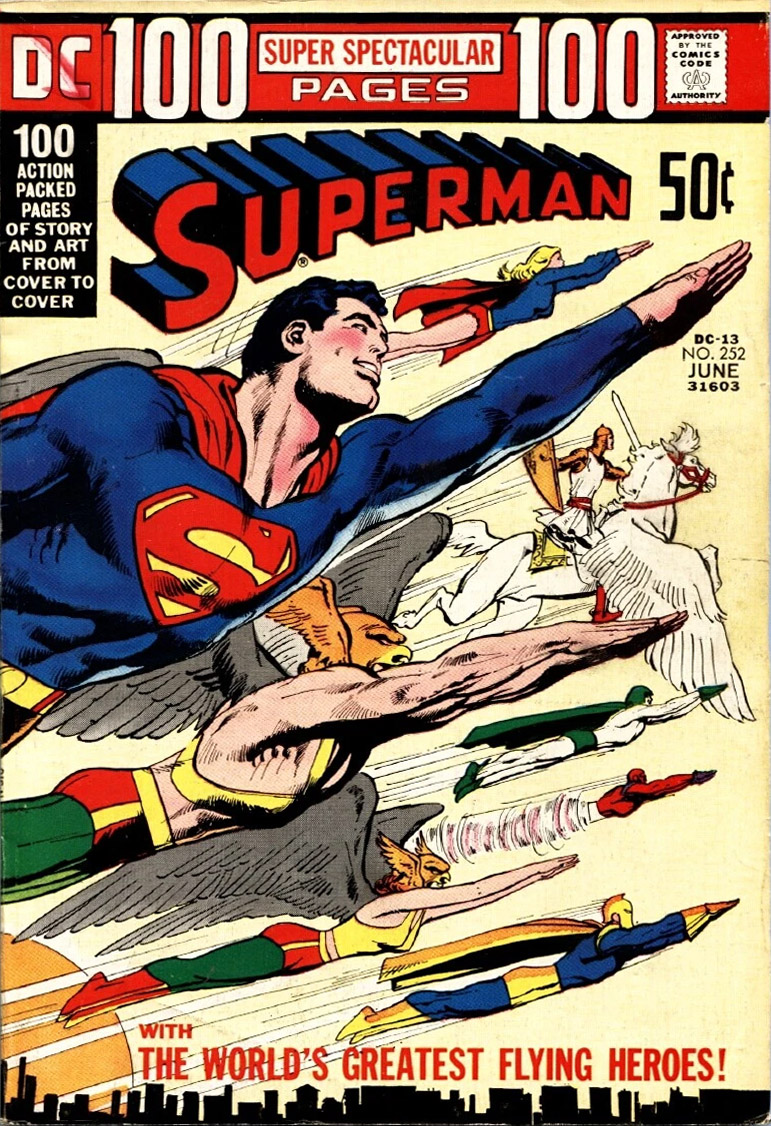
Robinson: I read the Superman #252 100-Page Giant that had the glorious Neal Adams wraparound cover featuring heroes who could fly—that was the theme of the issue. And on the cover and inside were stories featuring Black Condor and the Ray, and I had no idea who those characters were or their association with DC Comics. At the time I didn’t really understand that Kid Eternity was a Quality character. I’d just encountered him in the Secret Origins [#4] comic book in the same issue as the Vigilante and was struck by how the story felt different to me. Grimmer and more adult. As a kid I found it oddly appealing for that.
The first time I really began to understand who they were was as I grew a little older and bought Justice League #107–108, which was the first time the Freedom Fighters appeared, with the idea that there was Earth-X and they were fighting the Nazis. Bear in mind this was before the Internet and growing up in England, where we especially didn’t have this huge array of Golden Age comics that an American fan might have had just by going to a comic book convention. There was no opportunity to see old Quality Comics on sale and put “two-and-two” together. It seems crazy to say it now, but back then being a comic fan in England you had to be a bit of a detective to put it all together. (Obviously if I’d had the money to buy Steranko’s History of Comics books they would have explained everything, but that opportunity wouldn’t occur for years.)
I didn’t understand that DC had acquired other publishers since the 1940s, so the first time it all began to make sense was that Justice League story line introducing Earth-X. These Quality characters fascinated me because (like I’d already observed with the Kid Eternity story) they all had a completely different feel than DC characters, and also because, by and large, they had a lot of beautiful artwork. Obviously not all of it was wonderful but they had Reed Crandall, they had Lou Fine, and Eisner was doing work for them. I mean, the beauty of a Lou Fine page was something to behold. Where he’d do these nine-panel pages in “The Ray” and “Black Condor,” but then he would break the grid so that there were characters flying out of panels and coming at you. He was literally inventing the rules and then breaking them. Even as a little boy I found that incredibly exciting and unique.
Another character that helped you understand which company used to own which characters, and where they first appeared, was Plastic Man—seeing Jack Cole’s artwork, which was so unique and interesting and unlike anything else. So that was the first time I really encountered the Quality heroes and that always stayed with me. And as I’ve gotten to write, I’ve tried to find more of that original material on the Internet or by buying the actual comic books.
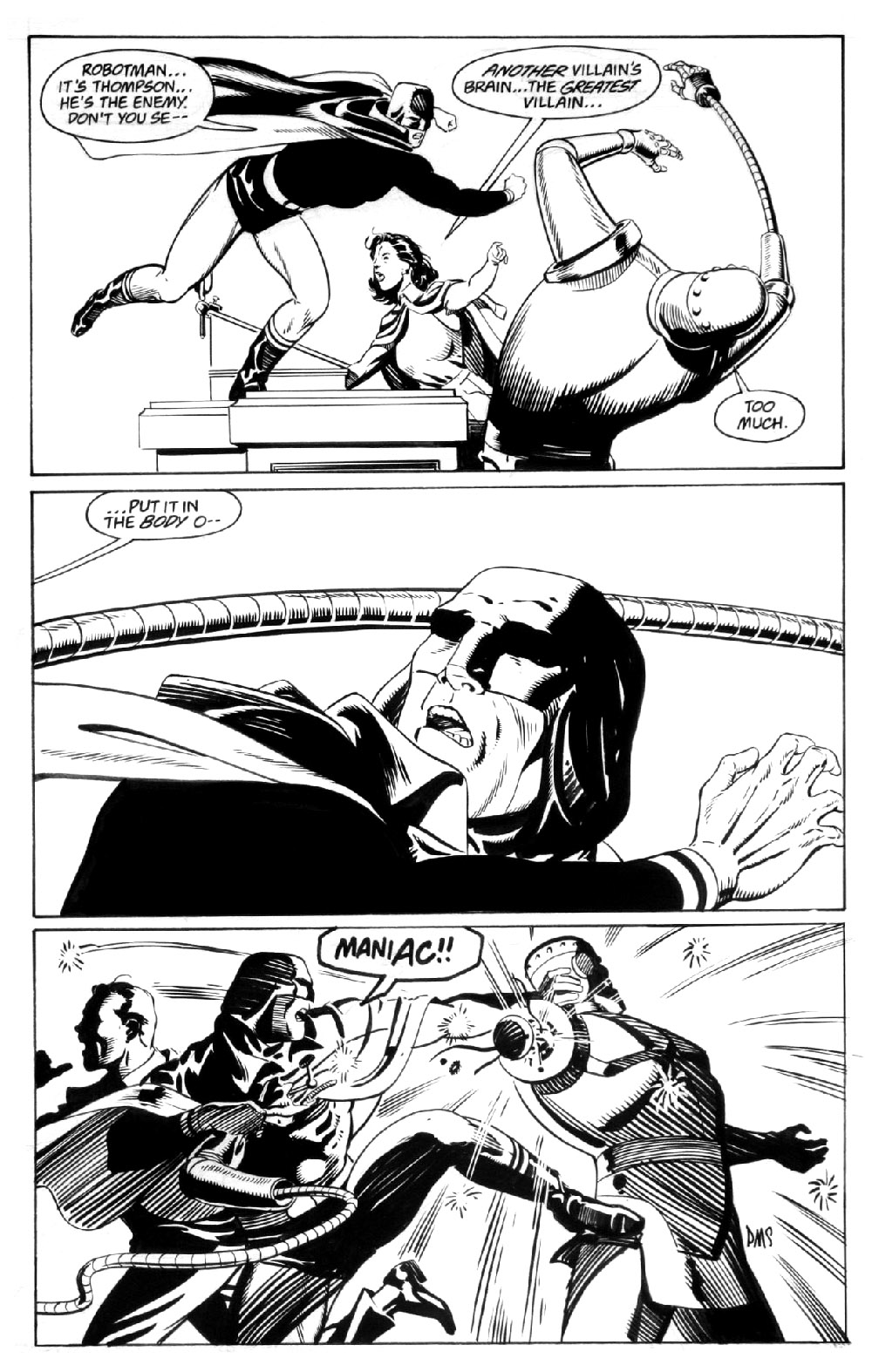
I first used Quality characters in the course of my first major DC work. It actually wasn’t my first DC work, but in the time it took to write it and get it out, I’d done some Legends of the Dark Knight [#32-34] which got published first. But The Golden Age was my first DC work. In it I had all the Golden Age heroes with the exception of Batman, Superman and Wonder Woman, all the characters that had parallels on Earth-One. I had free reign with all the Golden Age characters. I deliberately didn’t use the Fawcett characters but I wanted to use the Quality ones just because they had been incorporated into the Golden Age by Roy Thomas, when he did All-Star Squadron.
MK: Did you pitch The Golden Age?
Robinson: Yes. It was when Archie Goodwin first came to DC and he wanted to find a big project, so I pitched it and it was my intention to do something that was a little more serious and a little more—not a mature comic book in the way you would think of it now—but with a sophisticated, adult viewpoint on the 1940s. But at the same time, at no point was it grim and gritty in the way that sometimes these comic books can, I believe, go a little too far and sully the memory of what these comics once were. I was trying to walk a knife edge between doing something that was more serious, more adult, but at the same time honoring the stories that I enjoyed when I was growing up.
One of the characters that fascinated me, again from just one reprint in another Superman 100-pager [100-Page Super Spectacular #18 (July 1973)] (although the character really had no link to Superman) was Captain Triumph. I realized that nobody had used him and I was very happy to be the guy who actually got to incorporate Michael and Lance Gallant into a modern comic. And in issue four we had some cameos of other Quality characters appearing too.
MK: There were a lot of characters that appeared in cameo. Were those from notes that you provided to the artist, with suggestions for who to sneak in there?
Robinson: It was a combination of two things. Some of them were my suggestion, and also Paul Smith had a friend who was a lover of Golden Age characters and he suggested a couple of them. For instance, Wildfire had a cameo and quite honestly she’s a character I had not even heard of, so she would not have appeared if not for this friend of Paul’s. Other characters, like Stormy Foster, I had heard of and suggested.
MK: Miss America makes a significant appearance in the series. Was that inspired by her use in All-Star Squadron where she was retrofitted into the role of Wonder Woman?
Robinson: She was a bit inspired by that, yes. It’s interesting that Wonder Woman became quite a crucial part of the Justice Society as [All-Star Comics] went on, but Superman and Batman weren’t really vital to the book and only appeared once or twice. And yet, removing them from the Golden Age after the Crisis on Infinite Earths really took the steam out of the All-Star Squadron and I think took the steam out of Roy Thomas’ creativity at that time on the project. But I think those first 30 or so issues of All-Star Squadron where he incorporated Batman, Superman and the DC Golden Age characters along with some Quality heroes, then some Fawcett heroes a bit later, and made it all work—I was impressed by it and I thought it was a fantastic feat.
MK: Were you writing The Golden Age with the understanding that it was “Elseworlds” or did you originally approach it as if this was an in-continuity post-war story?
Robinson: It was written to be in continuity. It was written to be the “full stop,” putting the period on all those Golden Age stories and showing their twilight in a respectful and moving story. But as the project went on, I think it was Mike Carlin—who was one of the editors-in-chief at DC at the time—to whom we didn’t want to reveal the big ending (the fact that Dynaman had Hitler’s brain inside him). Because that’s such a goofy reveal, Archie and I decided that we weren’t going to tell anybody how the series ended. This was at a time when things were being leaked. Of course things get leaked now on the Internet, but it was even happening back then, the biggest example being that character from the future called Monarch who was originally meant to be Captain Atom. But that got leaked so they turned him into Hawk from “Hawk & Dove” at the last minute. [It happened in Armageddon.] We didn’t want the ending to the Golden Age to get out before its time because I felt I did a good job of having that reveal happen so that it wasn’t goofy—but it could have sounded goofy and put people off the book.
I think because Mike Carlin didn’t know how it ended, he got nervous about the whole project and decided that it was best that it became an Elseworlds project. And honestly, now there are things that have happened, like flashback stories to the 1940s that make the Golden Age redundant, but I’ve always written as if the Golden Age happened and that it was “the past.”
MK: I noticed that it seemed to be the genesis of Ted Knight’s mental illness and that some writers have picked up on bits and pieces in The Golden Age that have sneaked into in-continuity stories.
Robinson: That’s very flattering that the book is so well regarded that other people have chosen to consider that to be somewhat the Golden Age chronology, that my series fits into the overall chronology of the DC Universe.
MK: I don’t know if you know what happened to Captain Triumph in continuity, in the pages of The Titans...
He ends up getting murdered? Was he having an affair with Liberty Belle? You tell me.
MK: Yeah, he was dating Liberty Belle and I believe he was possessed by the ghostly brother and committed murders and ended up going to prison. But I thought that it was a pretty logical progression for the character, that after a while he would be really “haunted” by this brother and it’s not always going to be great to have him hanging around.
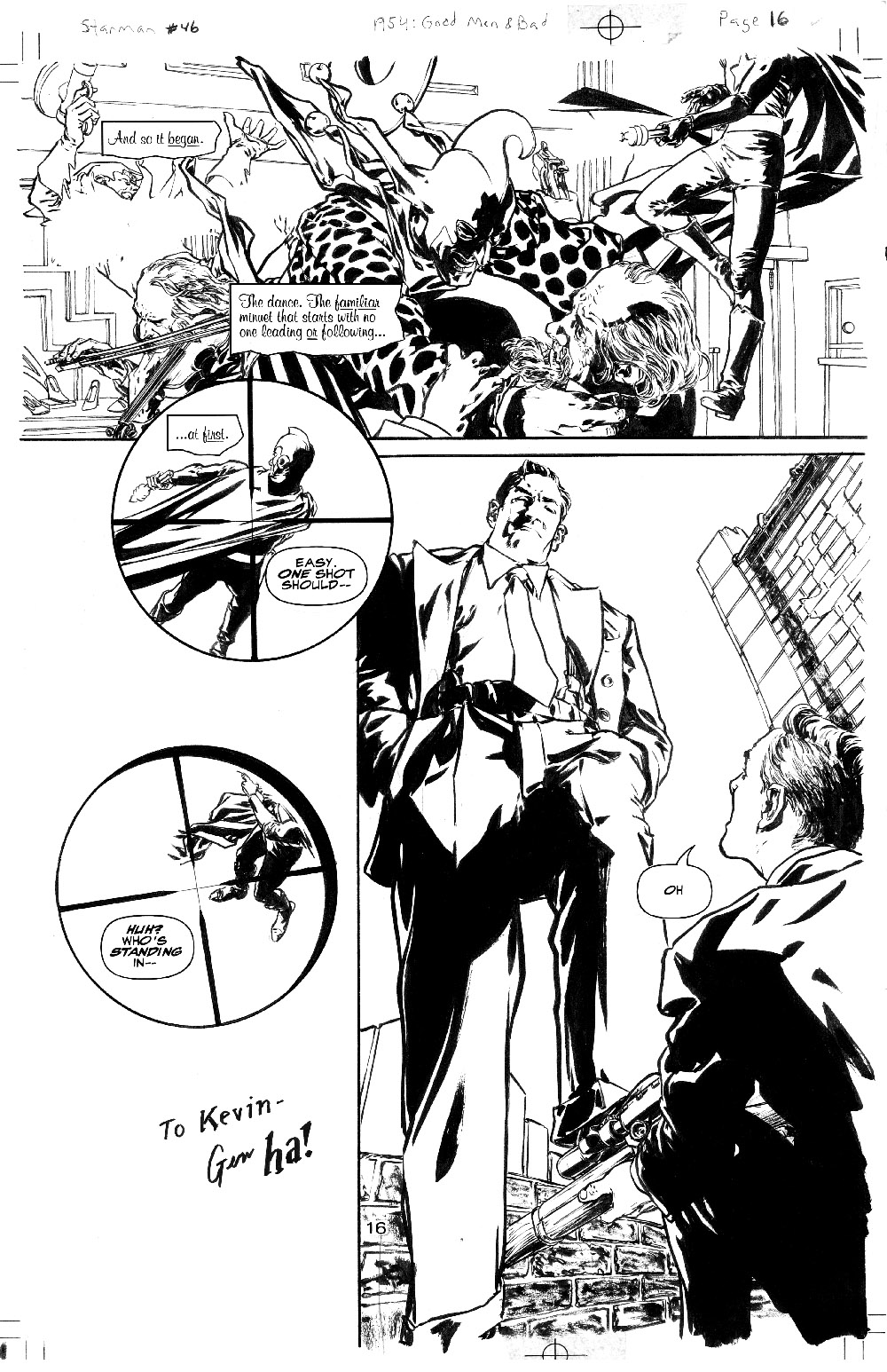
Robinson: After the Golden Age, I did Starman and it had been established by Roy Thomas that Ted Knight and Sandra Knight were related. So I played on that and actually got to write a Phantom Lady solo story and incorporated it into the story line with elements here and there. Then I had the pleasure of doing a “Times Past” with art by Gene Ha [Starman #46] that had the Jester making his first appearance in the modern day DC universe.
MK: If I could back up, I’d like to touch on a Phantom Lady detail… In one of those stories, she’s fighting the Prairie Witch and one of the biggest questions I’ve always had is: I don’t know if you know that back in her original adventures, she had a kind of love/hate relationship with another heroine called the Spider Widow? The Spider Widow also wore a green mask that looks kind of like the Prairie Witch, so I always wondered if this villainess was inspired by the Spider Widow.
Robinson: No, I didn’t know that. In fact I’ve never read a Spider Widow story. She had her own feature, didn’t she?
MK: Yeah, ironically they had the same writer, Frank Borth, and it was a rare crossover …
Robinson: I knew there was a guy called the Raven who was a love interest for the Spider Widow. I had no idea they had crossed over and had I known, I would have incorporated that into Starman in some way.
MK: There’s five or six stories that cross over in both of those strips with all three characters.
Robinson: Prairie Witch was a character that I created and I’m quite proud of it because she’s unique but she’s much like a 1940s villain. It’s a fine line; it’s hard to pull that off when you come up with a character that feels fresh and fun and that doesn’t feel goofy or too nostalgic but at the same time feels like it could have existed in the ’40s, realistically.

MK: So you touched on the Jester…
Robinson: I like the idea of these characters having a dignified ending or retirement. So the idea was that this was the Jester’s last case as opposed to him getting killed, or what have you. Instead you realize that now he’s a police detective whereas he was just a patrolman when he was the Jester in the 1940s. He evolved and moved on from being a super-hero. When I wrote that, it was my way of leading up—in my own mind, ultimately—to Jack Knight’s own retirement and moving on from being a super-hero.
MK: Then we got glimpses of people like the Red Bee, another lovable weirdo who appeared in the “Times Past” story…
Robinson: The Red Bee has always been treated somewhat as a joke. He had some pretty cool covers by Lou Fine, but even among people who love Golden Age characters, he’s considered one of the most pathetic. In Animal Man, Grant Morrison poked fun at him. I was just trying to give him a little dignity even though he had two trained bees.
MK: The biggest reinvention seems to have been the Spider.
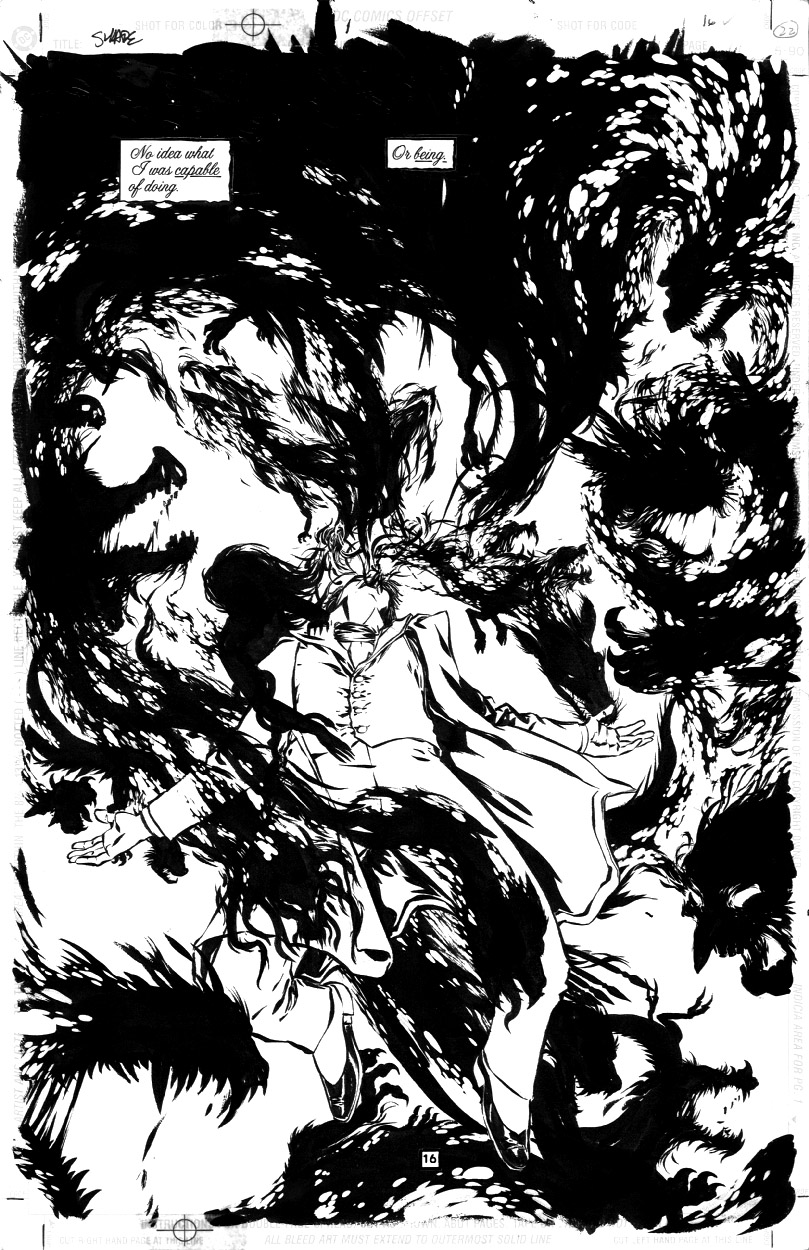
Robinson: Yes, in The Shade #3. Geoff Johns used the character after Starman was finished but it was my idea to have the Spider’s whole hero persona be a mask for his criminal activities. In hindsight, I realize that what I did was just flip the premise of the Green Hornet, who was a hero who acts like a villain. The Spider is a villain that’s acting as a hero. So I included him as one of the Ludlows in the whole family feud with the Shade. I don’t remember why or how, but it was fun to have his son return later as the new Spider of the present day. We saw him join the group of villains in “Grand Guignol” at the behest of Culp, the evil midget who was menacing the Shade.
MK: It seemed like the Spider’s son was sort of walking the line. He wanted revenge but wasn’t necessarily a villain “all the way”…
Robinson: Well, I think that was a slight tweaking that Geoff added to the character. When he was in Starman, he killed a guy by shooting him in the back; he was pretty villainous, in my opinion. I never intended him to be an anti-hero. He was always meant to be a villain in my mind. I think that’s really interesting.
MK: Did you know that Grant Morrison killed him off? It’s suggested in Seven Soldiers that he was killed by his brother: I, Spyder. I was wondering what your thoughts were on the I, Spyder character.
Robinson: The Seven Soldiers story line was a very fun, exciting read.
MK: You’re writing a new Shade series, correct?
Robinson: Yes, but I, Spyder isn’t in that series. There is one Quality character appearing in the series but it’s a surprise and I’m afraid I can’t tell you. [It was Madam Fatal.]
MK: I’m not like everyone who needs a spoiler for everything. I’ll be super happy to be surprised.
Robinson: I can tell you that they’re in the first “Times Past,” which is in [Starman] issue #4. It’s the return of another Quality hero that we haven’t seen in quite a while.
MK: I’m just going to breeze through a couple other Quality hero names and see if you have anything to say about them. In Starman we also read a brief mention of the Red Torpedo as he aided in the creation of the Starman of 1951.
Robinson: For some reason I like “Tom Swift-ian” characters that invent giant robots, giant submarines, etc., so it tied in nicely with the starship and it all made sense and I got to show the Red Torpedo, at least in one panel.
MK: And there were mentions of a couple characters that were in the “Shade’s journal.” The one I’m most interested in is the Clock, who’s never made an actual in-panel appearance. There was a discussion with the Shade about the fate of the Clock and being perhaps poorly regarded as a hero.
Robinson: Yes if you remember, it’s not the Shade talking about the Clock, but the other character. And the fact that the Clock is still alive in the end is one of the things that tips the Shade off that he’s being played for a fool by Howard Hughes and his lackey. So the Clock was alive at the end of the story.
MK: The Shade remarked that the Clock was a “barely adequate protector of the innocent.”
Robinson: That “barely adequate” remark is a reflection of the Shade, who’s very snide and a little bit pompous, so even if he likes somebody he doesn’t always compliment; he always has to be “ahead.” So that’s very much how he would describe a character like the Clock. But it isn’t necessarily how I feel about the character.
MK: Did you have the opportunity to read any of the original Clock stories?
Robinson: I found one.
MK: And a brief mention of Hercules in one of the journals?
Robinson: It was actually in a conversation between Alan Scott and Jay Garrick, talking about him, that he has Alzheimer’s …
MK: Good memory!
Robinson: Yeah, I kind of wish I hadn’t done that but at the time, it felt realistic.
MK: That brings me to a more recent character that you created in the pages of Superman who was Stormy Foster’s grandson, Von Hammer. Is that a character you hope to return to?
Robinson: Yes, in fact he’s a person that you’ll be seeing in The Shade maxi-series. There are references to Stormy Foster in the series.
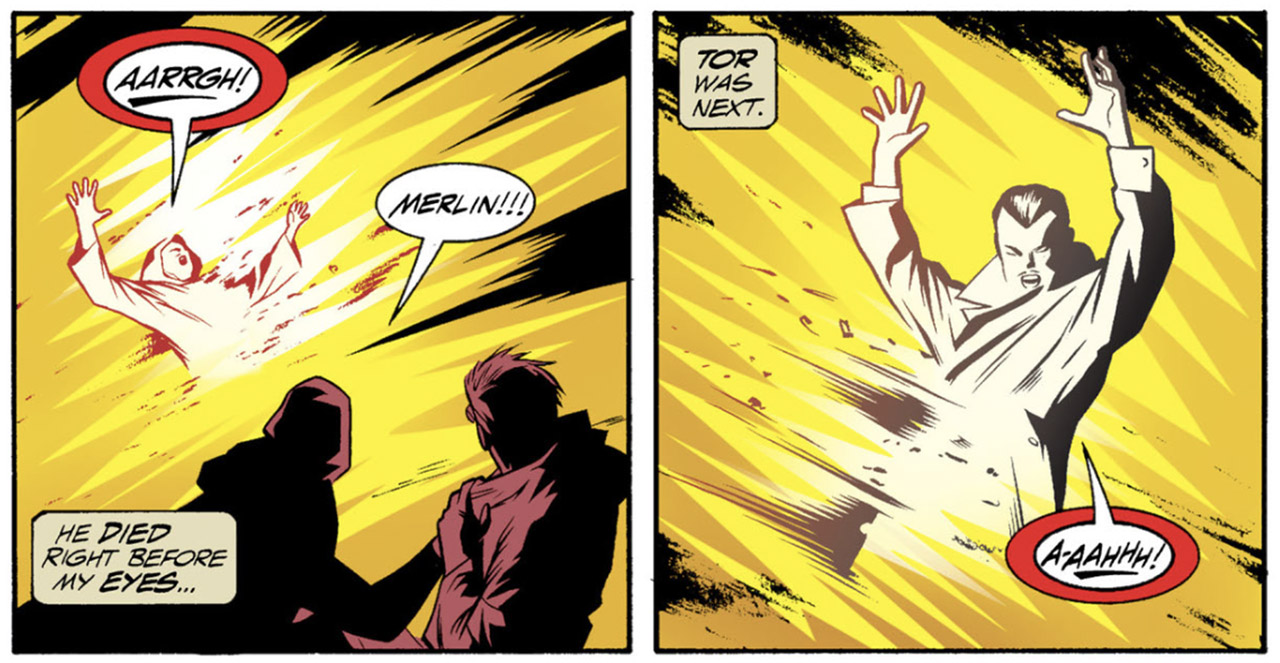
MK: Was it you that “killed” Merlin and Tor?
Robinson: It was, myself and David Goyer. They vanished around that point [in 1940s continuity]. They were only in the Quality books for a short period of time. Now I feel bad about killing anybody because I’ve gotten such sh*t for killing Lian in Cry for Justice. But at the time, it felt like the right thing to do and quite frankly, they weren’t the most original characters that Quality had come up with. So it wasn’t a huge loss really.
MK: I’d agree. If there were anyone you’d be justified to get rid of, it would be these “duplicate” kinds of heroes. And, well, some of them have to be killed off at some point, don’t they? I was struck by how you’ve got a love for Quality and DC characters, but I don’t see the same for Fawcett’s. Is that just because you haven’t had the same exposure to those characters?
Robinson: Yes, I think that’s accurate. I’m actually not a fan of the art in the Fawcett books, to be honest with you. I like C. C. Beck, but I’m not the greatest fan. I absolutely love Mac Raboy, so I love Captain Marvel, Jr. But when I see the artwork of these other characters, even someone like Spy Smasher, who was the equivalent to Batman—if Captain Marvel is the equivalent to Superman—even his art wasn’t particularly interesting to me. The bias also comes from the characters you’re reading at that formative stage, and there were a lot of Quality reprints in those 100-pagers. Whereas, for whatever reason—and I don’t know at what point DC acquired the copyright to the Fawcett characters—there weren’t any Spy Smasher reprints or Minuteman, or Commando Yank reprints. Had they been in those 100-pagers when I was reading them, perhaps I’d be as into Fawcett characters as I am Quality and DC characters.
MK: I’ve also veered around those characters maybe because I feel that there’s so much fandom surrounding Captain Marvel while Quality is such a big thing under the DC umbrella and it’s never been covered comprehensively. I know you’ve made some changes inside of DC continuity. Do you consider original published Golden Age stories “sacred”? I’m wondering how you decide to change continuity?
Robinson: Well, the thing about Golden Age books is that they were inconsistent from issue to issue. There are fans that look back at it and think that absolutely everything is ironclad in continuity. But often things contradict themselves. I don’t think that people who wrote it back then thought that people were going to be thinking about what stories came before, and to try and put it all together as one big picture. I think by and large, it was a job that someone did and they just wrote that month’s story line. So there was often glaring inconsistencies from month to month. With that in mind, I tried to honor the feel of these old stories, but sometimes I think it’s better for the character to approach it with the eyes of someone from today who is trying to create the modern-day continuity and have the sophistication of today’s storytelling.
MK: I’m reminded of the JSA "girlfriends story" [Starman #69], whose changes I appreciated. Your logic came across to me when I read that story.
Robinson: If you did that story exactly as it was done in the 1940s [in All-Star Comics #15], it would be incredibly goofy. It wouldn’t translate into the present day, but just by tweaking it a little bit I hopefully made it into a story that still harkened back to that time but had the feel of a modern story about it. Sometimes you have to take old continuity and massage it a little bit to make it work.James Robinson: A Selected DC Comicography
- Legends of the Dark Knight #32-34 (1992)
- The Golden Age, 4-issue limited series (1993)
- Starman, vol. 2, 80 issues (1994-2001)
- The Shade, 4-issue limited series (1997)
- Legends of the DC Universe #1-3 (1998)
- JSA #1-5 (1999)
- “Justice Society Returns” event, 9 one-shots (1999)
- Hawkman #1–2010 (2002-03)
- Detective Comics #817-820 (2006)
- Action Comics #874-889 (2008–2010)
- Superman #677-700 (2008–2010)
- Justice League: Cry for Justice, 7-issue limited series (2009–2010)
- Superman: World of New Krypton, 12-issue limited series (2009–2010)
- Justice League of America vol. 2 #38–60 (2009–2011)
- Superman: War of the Supermen, 4-issue limited series (2010)
- The Shade vol. 2, 12-issue limited series (2011)
- Earth 2, #1–16 (2012–2013)